by Mike Gulett –
Would you want a car that was pre-programmed to make life and death decisions for you?
That sounds like a puzzle from a science fiction novel, but it could become a meaningful question in the world of self-driven cars.
The person driving the car has always made the driving decisions. Sometimes those decisions are good and sometimes they are not so good. But we always knew who was making them. Now in the world of self-driven cars we will replace that driver with a computer.
Somewhere, somehow, someone will decide how that computer will react in situations that could result in a person getting hurt. Will the computer (the car) protect the passengers who paid for the automobile? Will it protect innocent pedestrians or people in other cars? Will it decide which decision produces the fewest people casualties?
Isaac Asimov, a science fiction writer, anticipated this type of dilemma more than 80 years ago. In 1942 he introduced his Three Laws of Robotics, which became among the most influential ideas in the history of science fiction.
The laws are simple:
First Law: A robot may not injure a human being or, through inaction, allow a human being to come to harm.
Second Law: A robot must obey orders given by human beings, except where such orders conflict with the First Law.
Third Law: A robot must protect its own existence, as long as such protection does not conflict with the First or Second Law.
Asimov was writing about intelligent robots but since a self-driving car is a robot on wheels his laws seem appropriate here.
The First Law says that a self-driven automobile must protect human life as a priority. The Second Law suggests that the car should obey its owner, provided doing so does not endanger any people. The Third Law says that protecting the automobile is less important than protecting people.
This all makes sense. But things become more complicated when we leave the science fiction world and enter our real world of cars on the road.
What Are Car Companies Doing?
Many car companies are creating more advanced driving systems. Engineering priorities include recognizing pedestrians, obstacles, trying to predict the behavior of other vehicles, and avoiding collisions. These goals are in line with Asimov’s First Law but we are not sure about the other two laws. But there is an big difference between programming a car to not harm any person and programming it to minimize the risk of harm to people.
Car manufacturers are businesses, they consider safety, legal liability, engineering costs, customer satisfaction, and corporate profits. But what do they do when these objectives conflict?
Would a car manufacturer program a car to sacrifice its occupants to save pedestrians? (what if there were more pedestrians in danger than people in the car?) Would customers buy that car if they knew that was the case?
Will Governments Consider Asimov’s Laws?
Some governments have already moved toward principles that are similar to Asimov’s ideas. In 2017, a German ethics commission considering self-driving recommended that human life take priority over property damage and that the computers should not discriminate among people based on their personal characteristics.
The United States federal safety guidance focuses more on testing, hazard prevention, system performance, and accountability than on these types of philosophical guidance. Neither approach adopts Asimov’s Laws as stated.
A law that says an autonomous automobile must never injure a human being sounds admirable, but it would be impossible to ensure. A more practical objective would be that self-driven vehicles be designed to reduce risks to human life.
The Lesson From Asimov
One of the interesting aspects of Asimov’s robot stories is that the Three Laws frequently failed to deliver the results their creators expected.
The laws were not a blueprint for perfect robots, they were a literary device for exploring the unexpected consequences of giving machines logical instructions.
A computer may eventually become a better driver than the most people. It may react faster, maintain constant attention without distraction, and avoid many of the mistakes people often make. But driving is not only a matter of following traffic laws, recognizing road signs and reacting. Driving involves judgment, uncertainty, anticipation, and sometimes choosing between more than one imperfect choices.
I think that self-driving cars will some day become, overall, safer than human-driven cars. But proving that will require extensive real-world evidence, not simply impressive demonstrations or optimistic promises from technology companies and certainly not flying cars.
I believe that Asimov’s Three Laws should be in this discussion, even if they never become actual legislation or programmed as written into the brain of our self-driven cars.
For more than 100 years, engineers have designed cars around the skills and limitations of people drivers. Now they are designing cars around the skills and limitations of computers. This is a big change, maybe more significant than the transition from gasoline engines to electric motors.
The irony is that we may someday trust computers to make better driving decisions than people, but those computers will still be following the rules laid down by their human creators.
Asimov believed that the real danger was not necessarily a robot disobeying instructions but it was a robot following those instructions perfectly and producing a result that nobody anticipated. I hope that possibility is in the minds of everyone involved in the creation of self-driving cars.
Unlike Asimov’s fictional robots, these cars, and their creators, will not have the luxury of another book chapter to explain what went wrong.
Let us know what you think in the Comments.
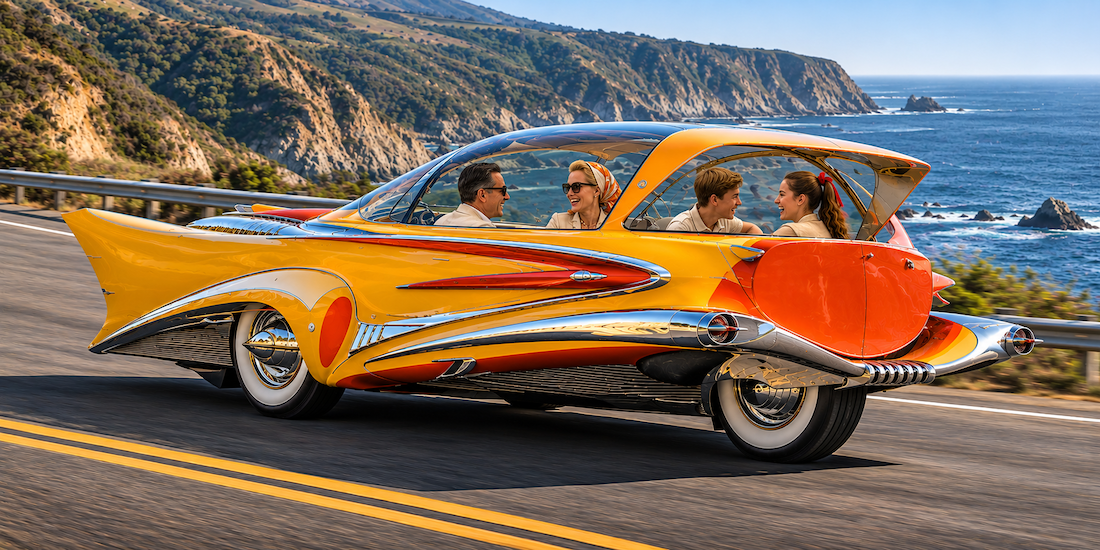
Research, some text and image by ChatGPT.



Back in 1956 a different kind of Sci Fi movie was released that actually required some thought to watch.
It was called “Forbidden Planet” and went into detail about a previous exploration that had discovered a planet ruled by a race called the Krell, so far advanced that no one could harness it’s strength and accomplishments, except for Morbius who led that first discovery expedition that inexplicably disappeared except for Morbius and his daughter.
One of the things that Morbius was able to learn from the Krell, led him to build Robbie the Robot who strictly followed Asimov’s Three Laws of Robotics. Not to give the plot away but Robbie, poor guy, winds up frying himself over those three laws.
Now that Morbius has tapped into the Krell unlimited power (Read AI) he forgot one thing, the ID or in common terms, the sub conscious and used that power without any restraints leading to a terrifying conclusion of self destruction.
A lesson for our times??