by Mike Gulett –
One day in the early 1970s when I was in college in Dayton, Ohio as I walked across campus I saw something in the parking lot that I had never seen before – a Triumph GT6. It was beautiful and caught my interest. I wanted one, so after graduation when I was able I went to the local Triumph dealer (yes they were still around then). I wanted a new GT6 but was told they were no longer made but they did have a new yellow TR6 on the showroom floor. I bought it and have never regretted it.
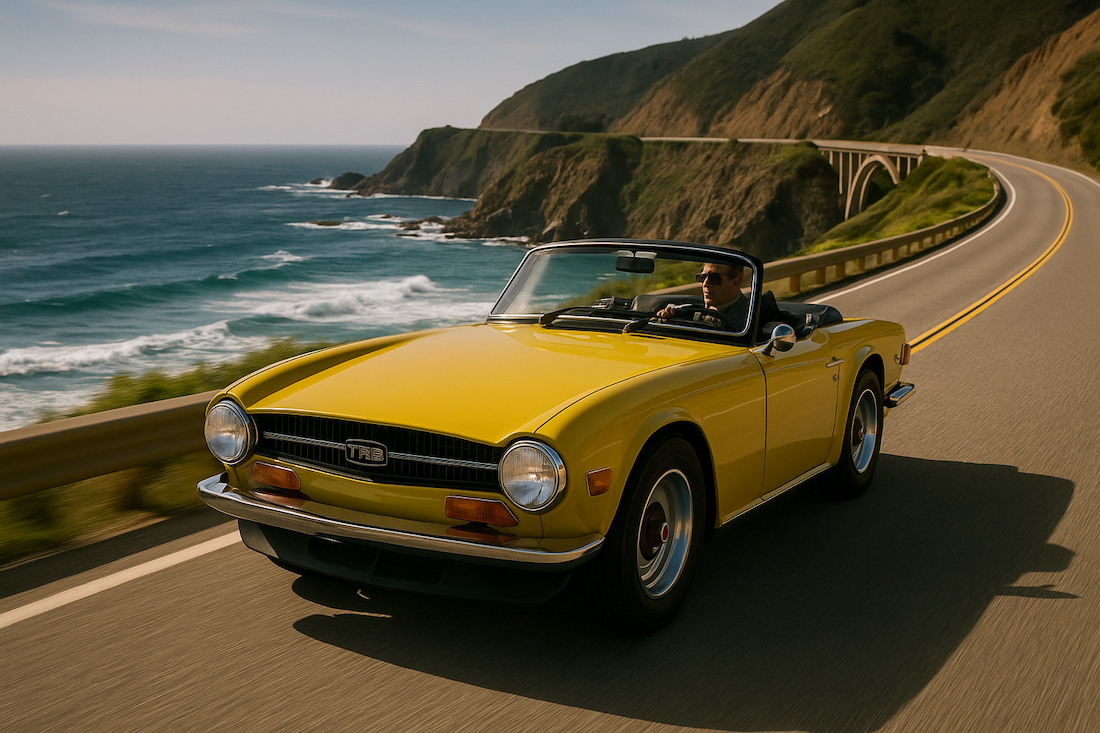
Triumph TR6
When it debuted in 1968, the Triumph TR6 arrived at a crossroads in automotive history. The traditional British roadster, long hood, short deck, torquey six-cylinder engine, and wind-in-the-hair driving, was beginning to feel pressure from tightening regulations, emerging safety mandates, and new competition from Japan, Italy, and America. Yet instead of fading away, Triumph created the TR6 one of their greatest successes. Today, the TR6 stands as one of the most recognizable and beloved sports cars of that time, a final triumphant chapter before British Leyland’s unpleasant decline.
Origins
The TR6 was the sixth generation of Triumph’s TR series, following the TR5/TR250. Mechanically, it was largely carried over: a sturdy ladder frame, independent rear suspension, front disc brakes, and Triumph’s smooth 2.5-liter inline-six. But its appearance needed modernizing.
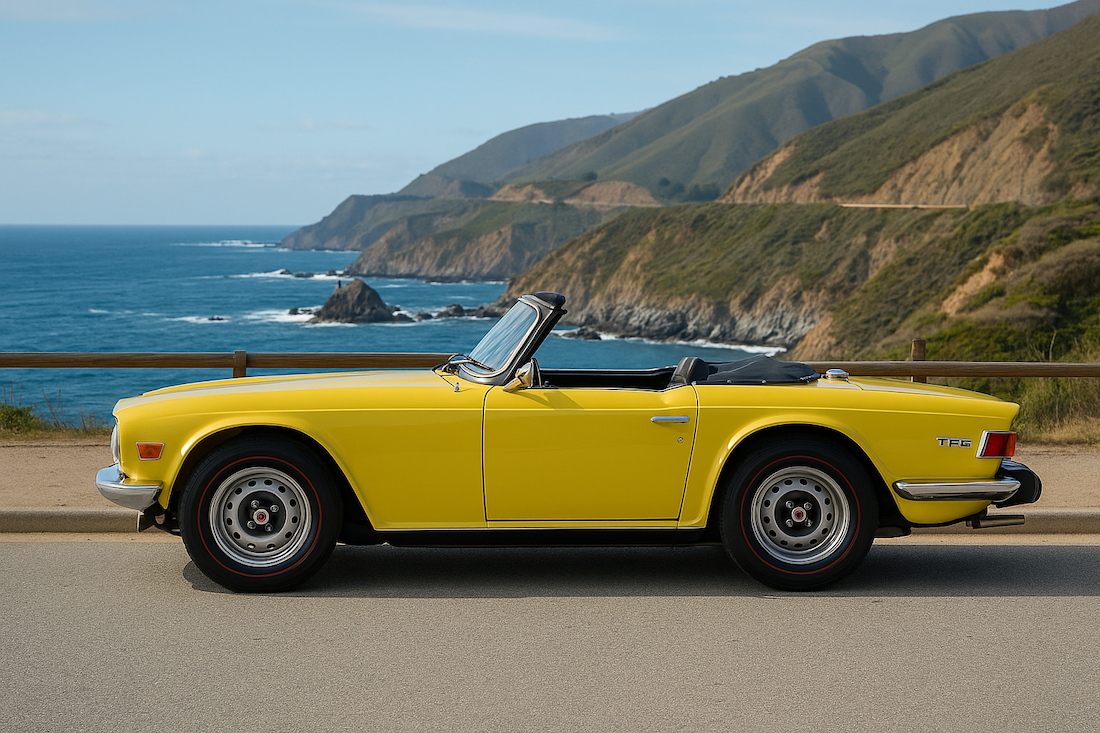
Enter Karmann, the German design house tasked with reshaping the TR’s shape. Working over Triumph’s existing frame, Karmann delivered a manly, modern look with clean horizontal lines, larger wheels, a blunt Kamm-tail rear, and a purposeful stance. The design was simple yet muscular, instantly recognizable and more contemporary than its curvier predecessors. The larger 15 inch wheels really stood out when other sports car wheels of that time were smaller.
Production began in late 1968 for the 1969 model year, and the TR6 quickly established itself as Triumph’s flagship roadster.
A Straight-Six with Character
The TR6’s character came from its shape and its engine. In Europe, the car featured Lucas mechanical fuel injection, producing around 150 horsepower. These petrol-injected cars were genuine performers, capable of 0–60 in under 9 seconds, a brisk figure for the time, and they offered a nice sound.
In the United States, emissions restrictions forced Triumph to use twin Zenith-Stromberg carburetors, reducing output to roughly 104 horsepower. While less powerful, the U.S. version retained the same mechanical charm: a broad torque curve, flexible mid-range power, and that unmistakable six-cylinder growl.
Other hallmarks included:
-
A four-speed gearbox with optional overdrive (important for freeway driving)
-
Fully independent suspension
-
Hydraulic brakes
-
A top that was quick to raise or lower
-
A cabin that, while basic, felt more refined than many peers
Even today, the TR6 remains enjoyable not because of speed but because of its purity: analog steering, predictable handling, and an engaging mechanical feel.
The Best-Selling TR of All Time
The TR6 became a runaway success. Between 1968 and 1976, Triumph produced 94,619 TR6s, more than any previous TR model. About 90 percent were exported, with the United States being by far the most important market.
Several factors contributed to its popularity:
1. Classic British sports car charm
It delivered everything enthusiasts loved: open-air motoring, a burly engine, and honest simplicity.
2. Competitive pricing
In the U.S., buyers could enjoy a straight-six roadster for far less than a Porsche 911 or even some Italian four-cylinders.
I paid $5,000 for my new TR6 in 1974.
3. Perfect timing
The TR6 hit the sweet spot before emissions regulations and the fuel crisis dramatically changed the sports car landscape.
4. Strong aftermarket and club support
Parts availability and active owner communities helped keep the TR6 on the road for decades after production ended.
Cultural and Historical Importance
The Triumph TR6 holds a special place in automotive history for several reasons.
A Symbol of the Final Golden Age
The TR6 represents one of the last truly traditional British roadsters—simple, mechanical, visceral—before the industry shifted toward more complex, safer, heavier cars. By the time the wedge shaped TR7 arrived in 1975, the world had changed. The TR6 remains a snapshot of a more carefree era.
Unfortunately for me I traded my TR6 in for a new 1975 TR7 and received $4,700 trade in value on the TR6 that had cost me $5,000 about 2 years earlier.
The End of Triumph’s Straight-Six Sports Cars
It was the final Triumph to use the 2.5-liter straight-six, a wonderfully characterful engine that had powered the TR5 and the sedans of the era. After the TR6, Triumph’s sports cars moved to four cylinders.
A Beloved Icon for American Enthusiasts
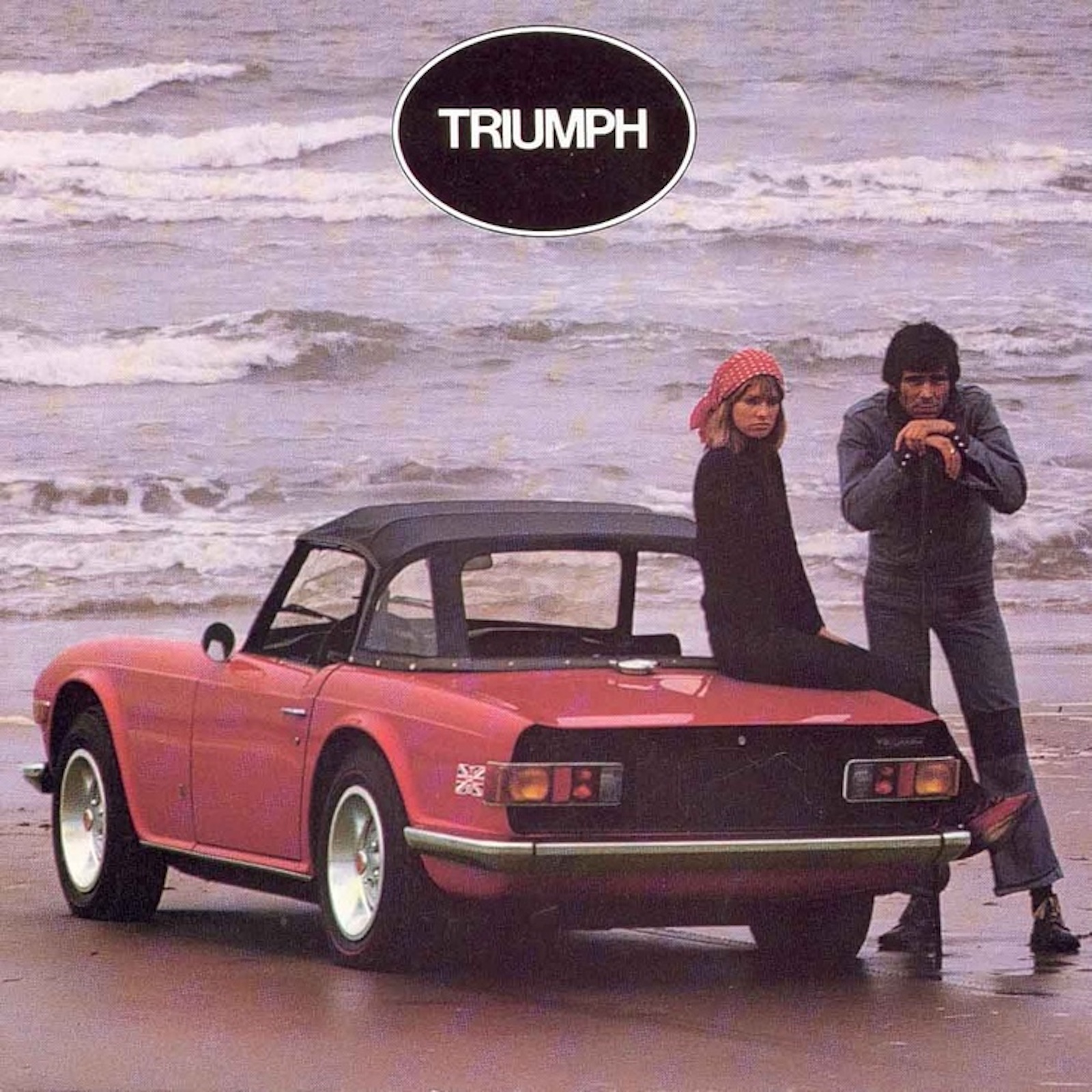
In the U.S., the TR6 became one of the defining British sports cars of the 1970s. Its mix of style, affordability, and personality made it a favorite among young enthusiasts and remains a popular classic today. With so many produced there are usually several available for purchase.
A Foundation of the Classic Car Hobby
Because the TR6 is durable, mechanically straightforward, and supported by thriving clubs and suppliers, it has become a cornerstone car for collectors. For many enthusiasts, it is the ideal entry point into vintage motoring.
Legacy
Four decades after the last TR6 rolled off the line in Coventry, England its appeal remains undiminished. It is prized not for rarity or over-the-top performance, but for something more personal, the joy of driving. The TR6 embodies a time when sports cars were elemental, mechanical companions not computers on wheels.
In an era dominated by technology, the TR6 stands as a reminder of the visceral pleasures of motoring: the sound of a straight-six echoing against the hillside, the feel of a mechanical gearbox, and the satisfaction of a classic design that has aged with grace. And what a beautiful design it is.
Let us know what you think in the Comments.
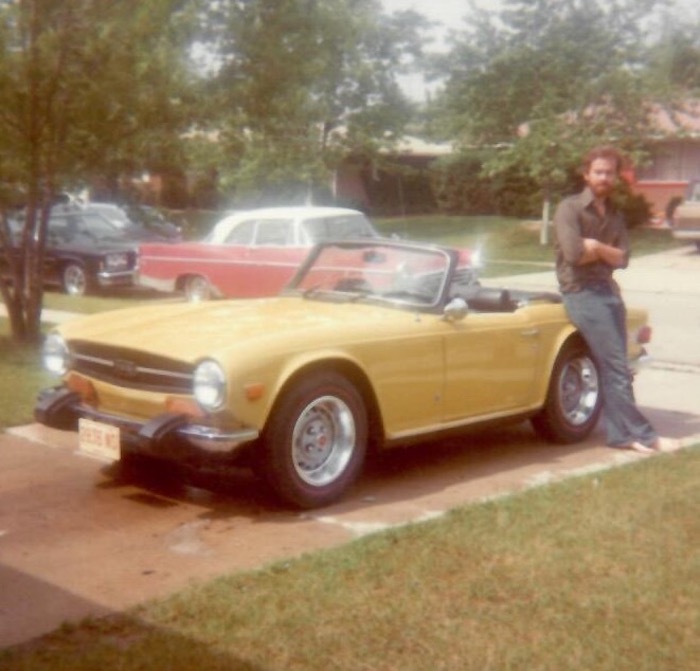
Mike Gulett and his Triumph TR6 in 1974 or 1975
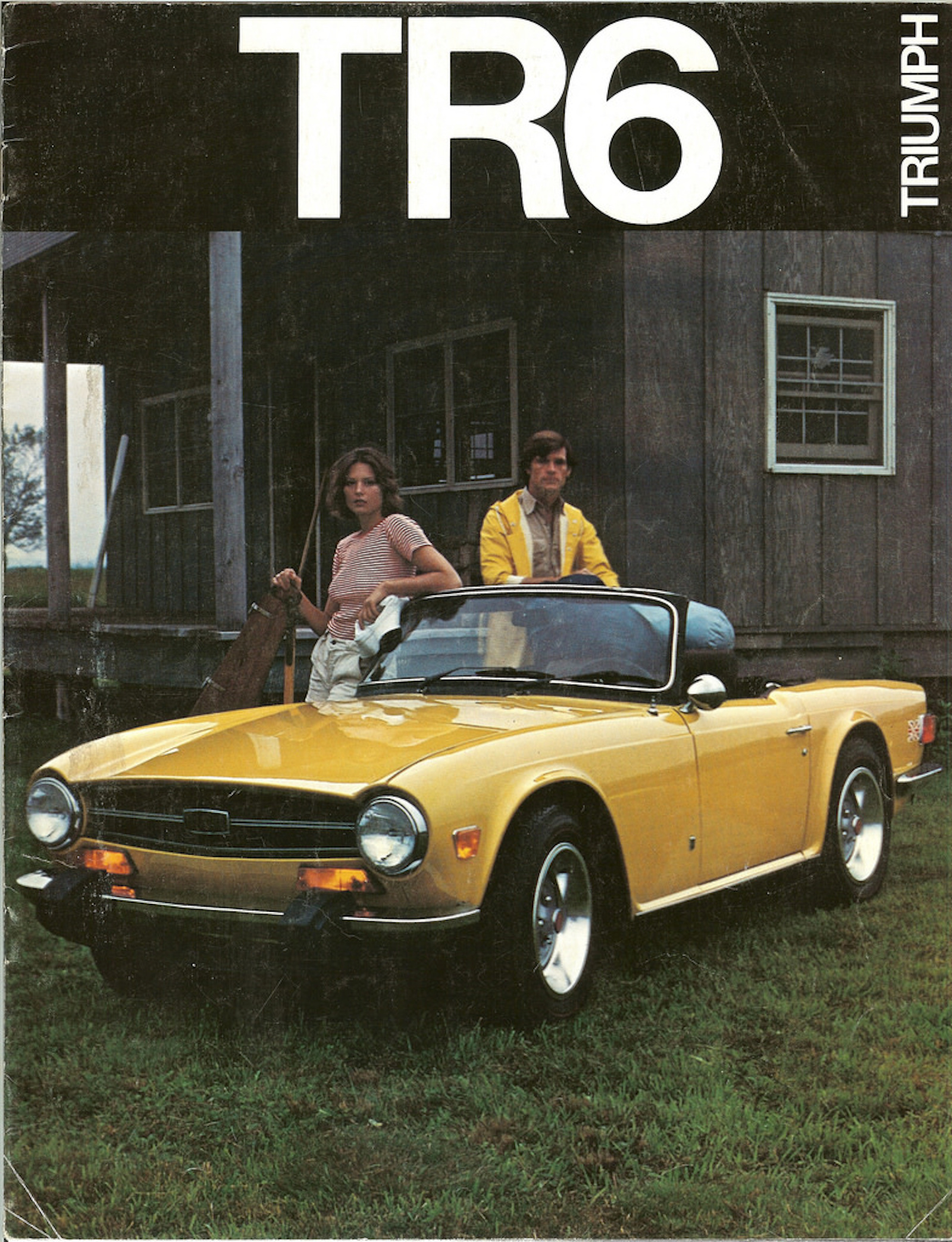
Research, some text and some images by ChatGPT 5. Some images compliments of Triumph.


Mike, I’m a Triumph fan having owned a ’69 GT6+. a ’73 and ’71 Stag. Never a TR6 though, but I’ve always wanted one. The Triumph straight six is a wonderful sounding engine. I first saw one as a teen living in Connecticut. A white TR6 drove past me on a country road (I was on my bike) and while coming into a corner, down shifted and then shifted up through the gears as it continued on its way. I’ll never forget the sound of that six as it went through the gears. A symphony! That’s what prompted me to get my GT6 some years later when in college. It was the second car I ever owned, in beautiful Valencia Blue. I wish I still had it and also my ’71 Stag which was perfect. The memories! Thanks for this article Mike.
In the ’70s, I went through a succession of TR-250s, so I’m appreciative of the TR-6. The sound of that sweet in-line six, the short throw 4-speed, and the immediate steering…what great fun on a twisty road! It’s a shame the TR-7 failed to carry on the legacy. However, as you point out, the TR-6 is an affordable classic with great parts support. They’re easy to work on, and still get admiring looks from younger car enthusiasts. All good attributes.