by Mike Gulett –
When I was about ten years old living in Los Angeles my best friend lived across the street and his parents drove a ’55 Chevy. It was two tone (teal and white). I got to ride in it sometimes and thought it was really cool. Later a long time family friend owned a ’57 Chevy that was a pale yellow color and for years that was the car I wanted. I never did own any ’50s Chevys and perhaps the ’56 version has become my favorite over the years. Eventually I came to realize just how important these “Tri-Five” Chevrolets were in the history of American cars.
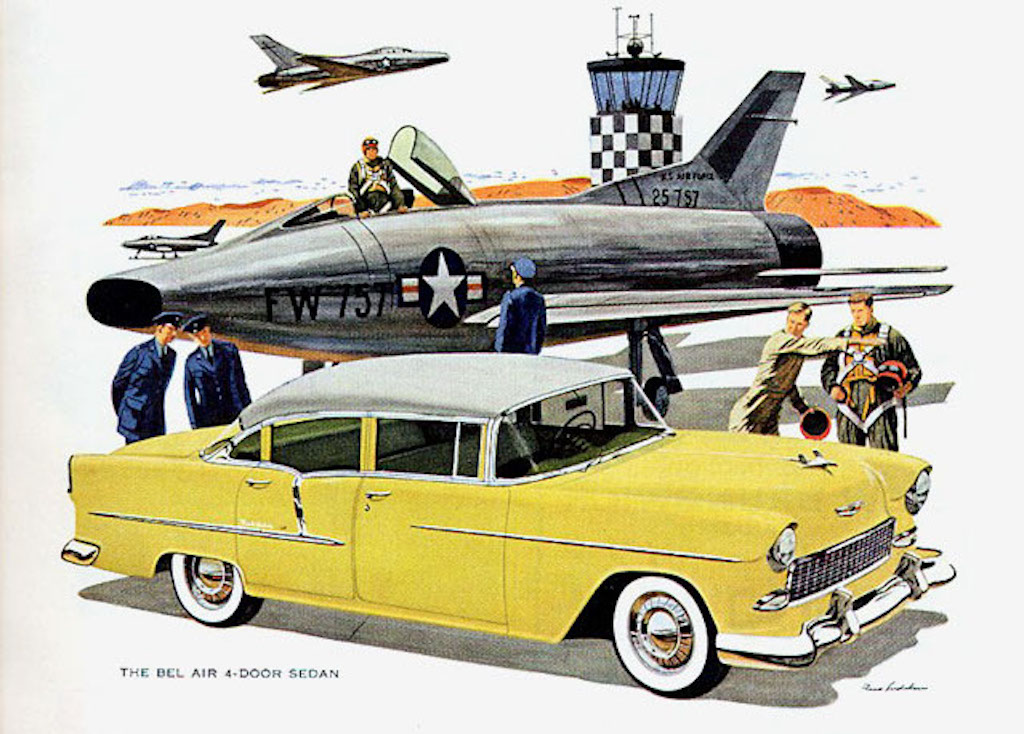
Few cars changed the American automobile culture as much the 1955 Chevrolet. It was not the most expensive car, nor the most luxurious. But it arrived at the right time—with the right engineering, the right styling, and the right price. It transformed stodgy Chevrolet from a conservative brand for our grandparents into a performance and style leader suitable for hot rodding.
Today the 1955 Chevrolet stands as one of the most influential cars ever built in America.
A Turning Point for Chevrolet
In the early 1950s, Chevrolet faced a big problem. While the company sold cars in huge numbers, its designs were often viewed as safe and somewhat dull compared to rivals like Ford and Chrysler. Then came the 1955 Chevy.
This car was the first of Chevrolet’s completely new lineup for the mid-1950s, often called the “Tri-Five” Chevrolets (1955–1957). The 1955 model launched the era with a clean-sheet design that looked modern, light, and more youthful than anything Chevrolet had built before.
Chevrolet suddenly looked exciting and fun again.
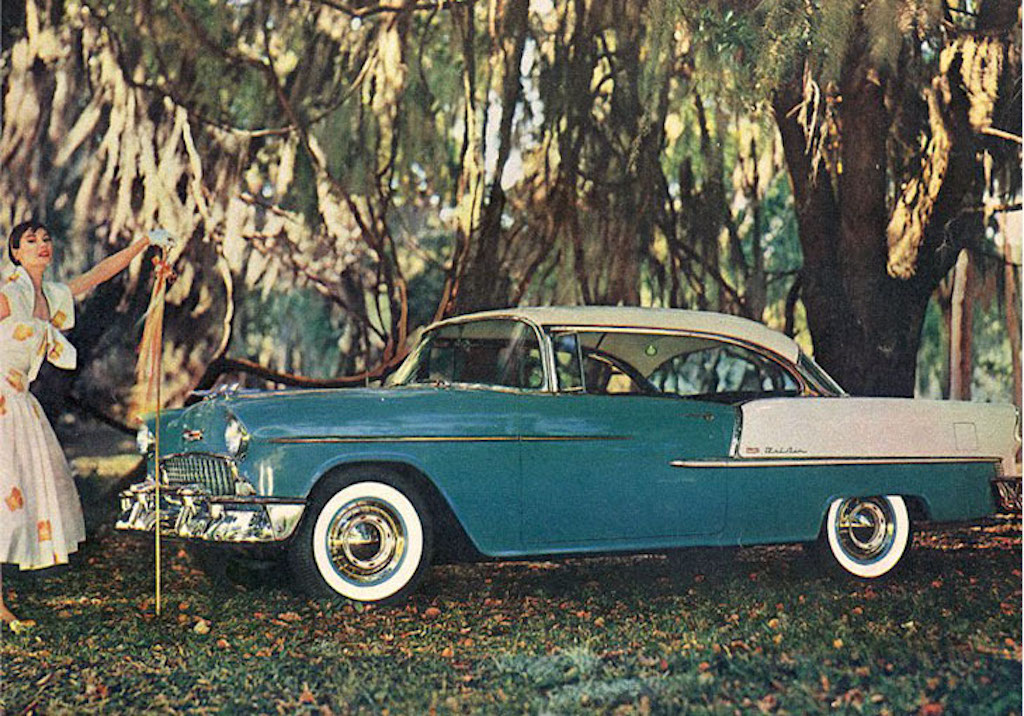
The Small-Block V8
The most important innovation was the introduction of Chevrolet’s brand-new 265 cubic-inch V8 engine.
Until then, Chevrolet had relied primarily on its dependable but old inline-six engine. This new V8 changed everything.
This engine was:
-
Compact
-
Lightweight
-
Powerful
-
Easy to modify
It produced up to 180 horsepower with the optional four-barrel carburetor—serious performance for a mid-priced American car in 1955.
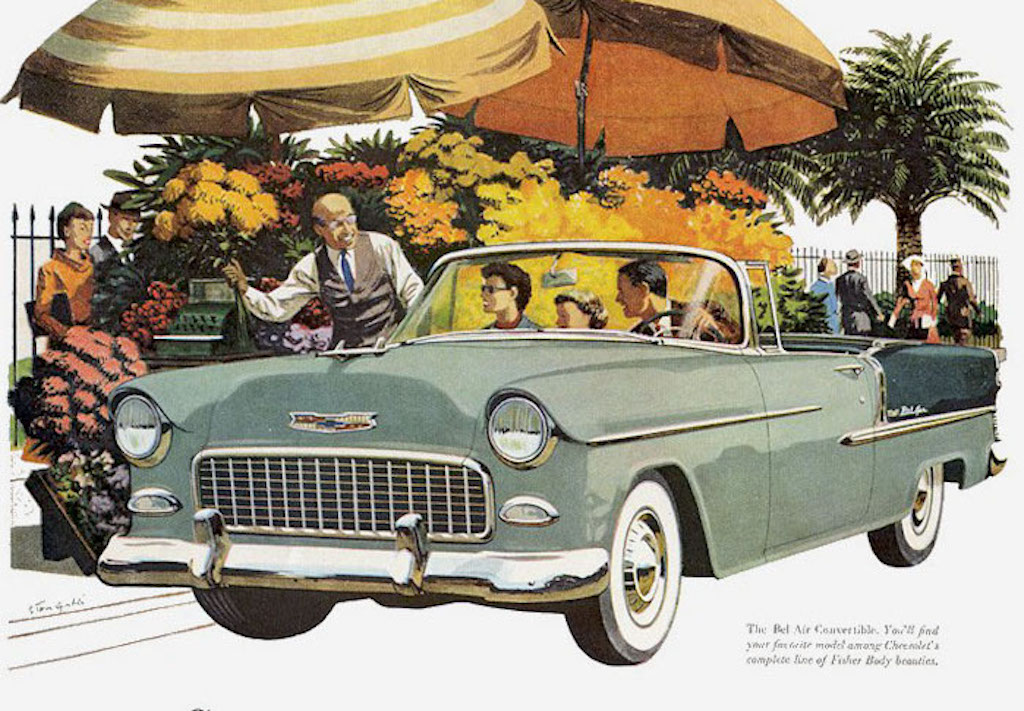
More importantly, the small-block design proved very adaptable. Over the decades it would evolve into one of the most successful engines in automotive history, powering everything from family sedans to racing cars.
Hot rodders embraced it. Mechanics loved its simplicity. Racers loved its power potential.
In many ways, the small-block Chevrolet V8 became an important part of American performance culture. It can even be found in Ford hot rods and custom cars.
1950s Styling
The 1955 Chevrolet also looked different from anything that came before. The design was cleaner and more modern than earlier Chevrolets, with:
-
A wide, confident grille
-
Small tailfins
-
Sweeping side trim
-
Balanced proportions
The car felt lighter and more nimble than the heavy, chrome-laden designs of the early 1950s.
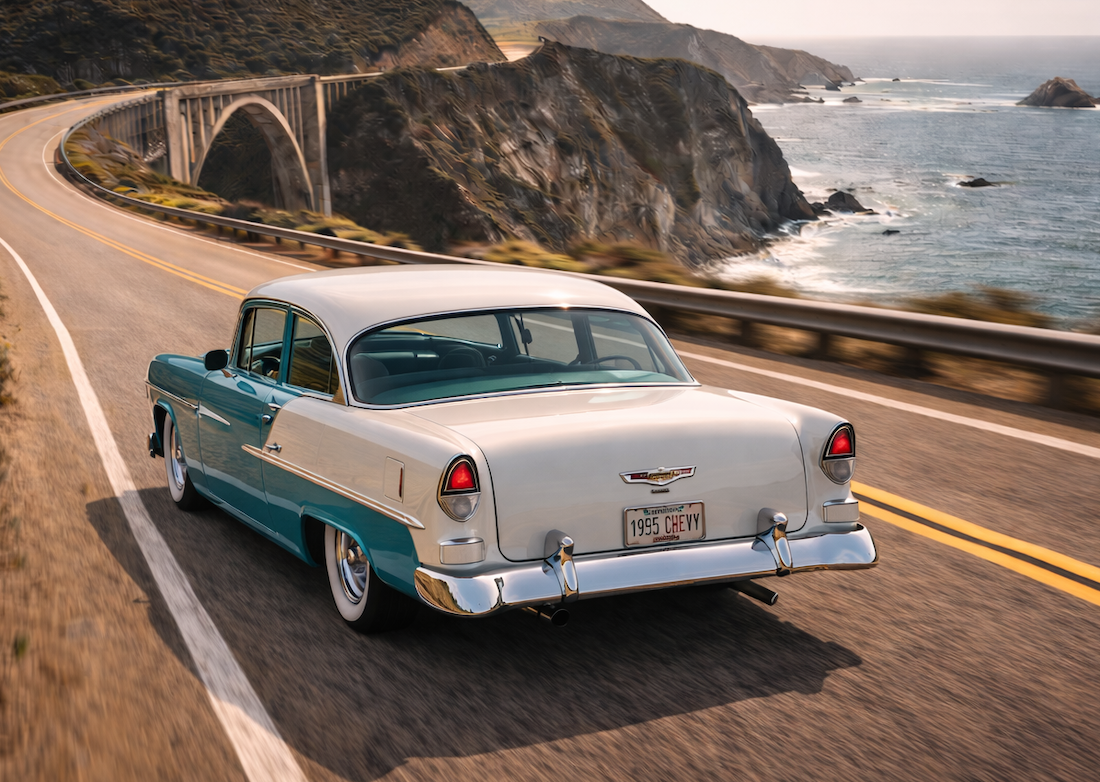
The Bel Air model, in particular, became desirable with its dramatic two-tone paint schemes and polished stainless trim running along the body.
The ’55 Chevy captured the optimism of mid-century America—modern, energetic, and forward-looking.
Speed for the Everyday Driver
Another reason the 1955 Chevrolet mattered was accessibility. This was not a rare sports car or an expensive luxury car. It was an affordable family car that ordinary Americans could buy, yet it delivered performance that competed with far more expensive cars.
With the new V8, improved suspension, and optional Powerglide automatic transmission, the ’55 Chevy offered a driving experience that felt lively, modern and youthful.
For many Americans, the 1955 Chevrolet was their first taste of real performance.
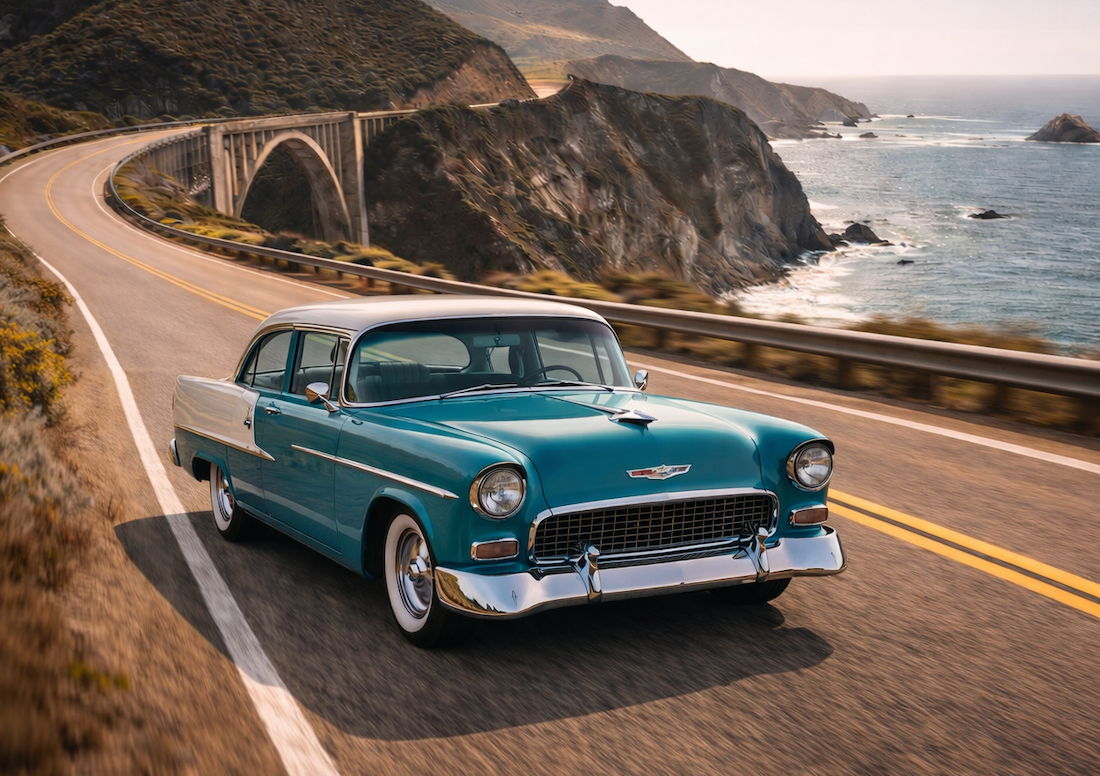
Hot Rod Culture
Few cars have been modified, customized, and raced as much as the 1955 Chevrolet (probably not as much as the ’32 Ford but a lot).
Its popularity among enthusiasts is driven by several factors:
-
The strong but simple chassis design
-
The adaptable small-block V8 engine
-
Plenty of parts availability
-
Timeless styling (we still love it today)
Hot rodders, drag racers, customizers, and restorers have all embraced the car. Even now, more than seventy years later, it remains one of the most popular cars for restoration and modification.
The phrase “Tri-Five Chevy” has become shorthand for a golden era of American car culture.
A Cultural Icon
The 1955 Chevrolet quickly became more than just easy transportation—it became part of our American identity.
It appeared in:
-
Movies and television
-
Classic rock album covers
-
Hot rod magazines
-
Car shows and cruises
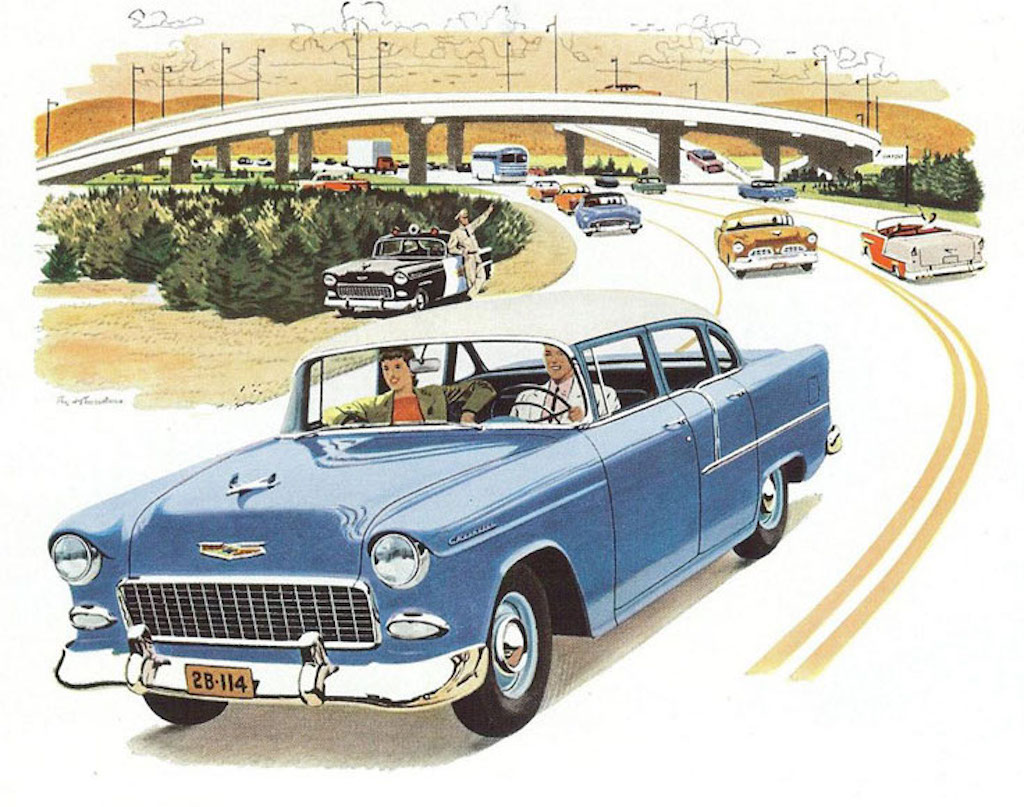
I remember the Harrison Ford character driving a black ’55 Chevy in American Graffiti looking to race Milner’s yellow ’32 Ford Coupe. Unfortunately the ’55 Chevy was wrecked in the big race.
For many car lovers, this car represents the optimism of 1950s America—a time when highways were expanding, suburbs were growing, and the automobile symbolized freedom and all sorts of possibilities.
Few cars capture the spirit of the 1950s so completely as the ’55 Chevy.
The 1955 Chevrolet Still Matters
Today, the 1955 Chevrolet remains one of the most beloved classic cars ever.
Its importance comes from a rare combination of factors:
-
A revolutionary engine
-
Fresh, modern styling
-
Affordable performance
-
Deep cultural roots
The 1955 Chevrolet proved that a mass-produced car could be stylish, powerful, and attainable at the same time. It helped ignite America’s love affair with V8 performance and laid the groundwork for decades of hot-rodding and muscle car culture.
More than seventy years later, the 1955 Chevrolet still represents something special. It is not simply a classic car.
It is the moment when Chevrolet—and much of American car culture—found its stride and I am so pleased they did.
Let us know what you think in the Comments.
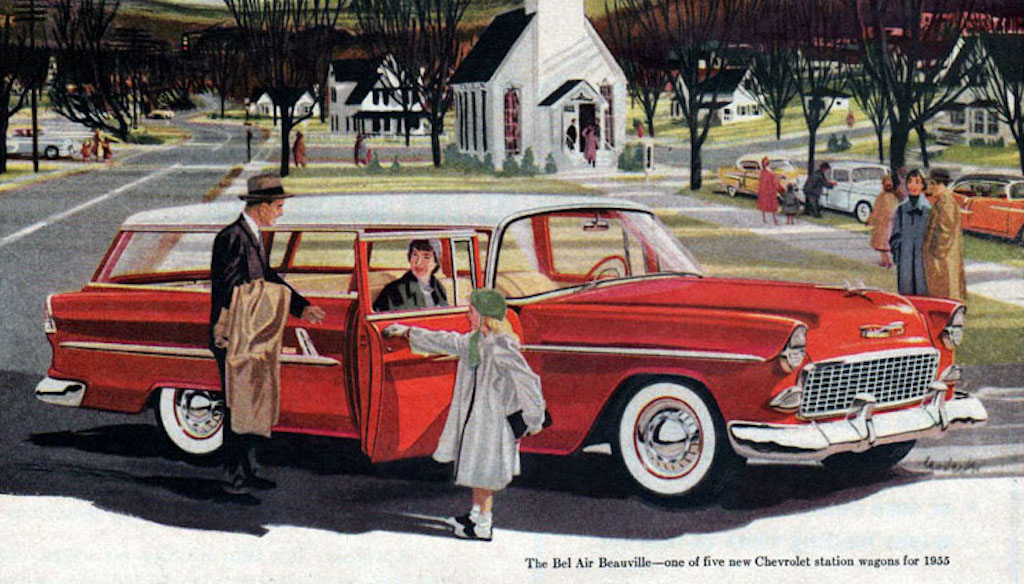
Research, some text and some images by ChatGPT 5.2. Some images compliments of Chevrolet.


Amen Mike!
My first car was a ’55 Bel Air sold to me for $50 by my gracious Grandfather who had bought it new, seven years before. It had the 265 V8, only a two barrel carb but I took care of that later with a four barrel and a switch from three on the tree to a Hearst three on the floor.
The car was two toned white and teal, as you had mentioned, but since it was probably never waxed, had a dull almost flat look. Since I was commuting to college and the 4 barrel and Hearst had cost some money, I sprung for a $50 Earl Sheib (“I’ll paint any car any color for $50”) in dark metallic blue with chrome rims on the wheels.
Too many stories to tell but that 265V8 had solid lifters and you could wind the heck out of it on the highway beating the 50’s Fords and Mercs in short races.
What a great memory.
Stephen – now that is an affordable ‘55 Chevy!
Mike, agreed the Tri-Five Chevys were a great set of vehicles. I believe the Duntov Memo from 1953 set the stage for development of Chevrolet performance and resulting popularity. You should consider doing a complete article on the Duntov Memo.
Best regards / Bob
Robert – thank you for the suggestion – very interesting idea.
Mike,
Yes, I agree, and I used to be a big fan of the Tri-Five Chevys, for about 40 years. Then, I discoverd the Tri-Five Chrysler Corporation products with their Virgil Exner “Forward Look”.
“……..its designs were often viewed as safe and somewhat dull compared to rivals like Ford and Chrysler. Exactly!!! The Tri-Five Chevys were short and stubby compared to the Tri-Five Desotos, Dodges, Plymouths, and Chryslers.
And, it was not just the styling. Look at the engine choices:
“In 1955, Chrysler Corporation offered a diverse engine lineup headlined by the 331 cubic-inch FirePower Hemi V8, producing up to 300 hp in the 300-hp Chrysler C-300. Other engines included the new 301 ci Polyspherical “Semi-Hemi” V8, 270 ci Red Ram/Super Red Ram V8s, and 230 ci straight-six engines.
Yes, the Chevys always get the glory, but the Chryslers were actually superior cars.
Glenn in Brooklyn, NY
One day as I was visiting my girlfriend in Tampa I noticed a 55 Chebby sitting next to her neighbor house. I knocked on the door and was told the car was not for sale. I repeated this exercise for over a year. Finally one day my mom told me that someone had called looking for me. I returned the call and was told to come over about that car I was interested in. $50.00 later I had in my possession a Coral over gray BelAir two door hardtop. This was the summer of 1969. Needlessly to say I was in hog heaven. Stupid me repainted it metallic blue, replaced the 265 with a stout 327 and fitted it with a Hurst shifter. The car was the hit of my high school parking lot. Who ever rode in it payed the gas bill. I killed it eventually by rolling it inside the most prominent drive in theater in town.