by Mike Gulett –
Most of the time deciding who was responsible for an automobile accident has been straightforward as long as humans were driving. But what is to be done when no person is driving? This is becoming a more important question as we see more self-driving cars like the Tesla Cybercab.
If a self-driving vehicle causes an accident, who is responsible? This is no longer a hypothetical question. Autonomous vehicles are already operating on public roads in some areas, and lawmakers, insurance companies, manufacturers, and courts are all trying to answer a question that we have never had to ask before. Who is the legal driver when a computer is driving?
The Driver May Not Really Be the Driver
Most of today’s “self-driving” cars are not actually self-driving. Tesla’s Full Self-Driving (Supervised), Mercedes-Benz Drive Pilot, Ford BlueCruise, and General Motors Super Cruise are designed to assist the driver, not replace the driver. Legally, that distinction is very important.
If the system requires human control then the human is responsible. The law usually assumes that the driver is watching the road and prepared to take over at a moments notice.
But What If Nobody Is Driving?
In a Level 4 autonomous vehicle there is no steering wheel and no pedals like the Tesla Cybercab. Passengers just tell the car where they want to go.
But what if during the trip, another car turns left in front of you. The autonomous car brakes but cannot avoid a crash. Who is responsible? Who is the legal driver?
Now responsibility shifts away from the passenger and toward the car manufacturer and the technology that made every driving decision.
The Lawsuit Structure Changes
Instead of asking what did the driver do wrong? These lawsuits will ask what did the car (including the software and hardware) do wrong? This now looks like a product liability case and the courtroom is less like traffic court and more like a technology product trial.
The Black Box on Wheels
Today’s self-driving vehicles record lots of information. The computer memory remembers just about everything.
The vehicle may know:
- What every camera observed
- What the radar detected
- What the lidar measured
- When braking began
- Steering inputs
- Vehicle speed
- Driver-monitoring information
- GPS position
- Software version
- System warnings
- Diagnostic information
This digital record may become the equivalent of an aircraft’s flight recorder (the black box).
Investigators may be able to reconstruct exactly what the vehicle “saw” and how it decided to respond. That can be both reassuring and unsettling. It may produce far more accurate accident investigations—but it also raises questions about individual privacy, data ownership, and who has the legal right to access the vehicle’s records.
Software is Always Evolving
One aspect of autonomous vehicles that has no precedent is that they continue evolving after they are sold through software updates sent wirelessly.
Automobiles have become computers on wheels, and computers are constantly moving forward. This can create legal questions that previous generations never had to answer, namely if there is a software defect that causes an accident who is responsible? What if there is a new software update that would solve the problem but the car owner did not download the update?
Insurance Will Have to Change
Today automobile insurance companies assume that people drive cars. Insurance companies are preparing for a future in which claims increasingly involve software functionality rather than driver behavior.
Over time, more and more responsibility could migrate toward the companies that design and operate the autonomous systems.
Is It Possible For a Computer To Be Negligent?
Can software be negligent? Maybe not — negligence is a legal concept applied to people and organizations—not machines.
If a self-driving car makes a bad decision, the current legal system will look for human responsibility somewhere.
The computer may make the real-time mistake. But the law will still look for a human or company behind the machine to assign blame.
Other Problems
Every jurisdiction (states in the US and different countries) may have different laws. California may regulate autonomous vehicles differently than Texas or Florida.
Insurance requirements, licensing rules, testing procedures, and liability standards will likely vary from one jurisdiction to another creating headaches for car manufacturers and owners.
The more liability car manufacturers assume, the more control they may seek over their vehicles. That could mean restrictions on:
- Unauthorized software modifications
- Performance tuning
- Third-party repairs
- Sensor replacements
- Operating outside approved geographic areas
- Certain weather conditions
For car owners who have always believed that buying a car means owning it, this represents a significant philosophical shift.
A Legal Question
We have been used to the philosophy that “if I control the vehicle then I am responsible for what happens when I drive it”.
But if a computer controls the self-driving car then responsibility will shift toward the people and companies that created, tested, maintained, and updated that computer.
This change will reshape vehicle insurance, the legal system and perhaps the entire relationship between people and their automobiles.
As car lovers, we ask whether self-driving cars will ever be as much fun and as rewarding as driving ourselves.
Lawyers, the courts and politicians will be working out the answer to a much different question in the coming years that will likely affect us all eventually, like it or not.
Let us know what you think in the Comments.
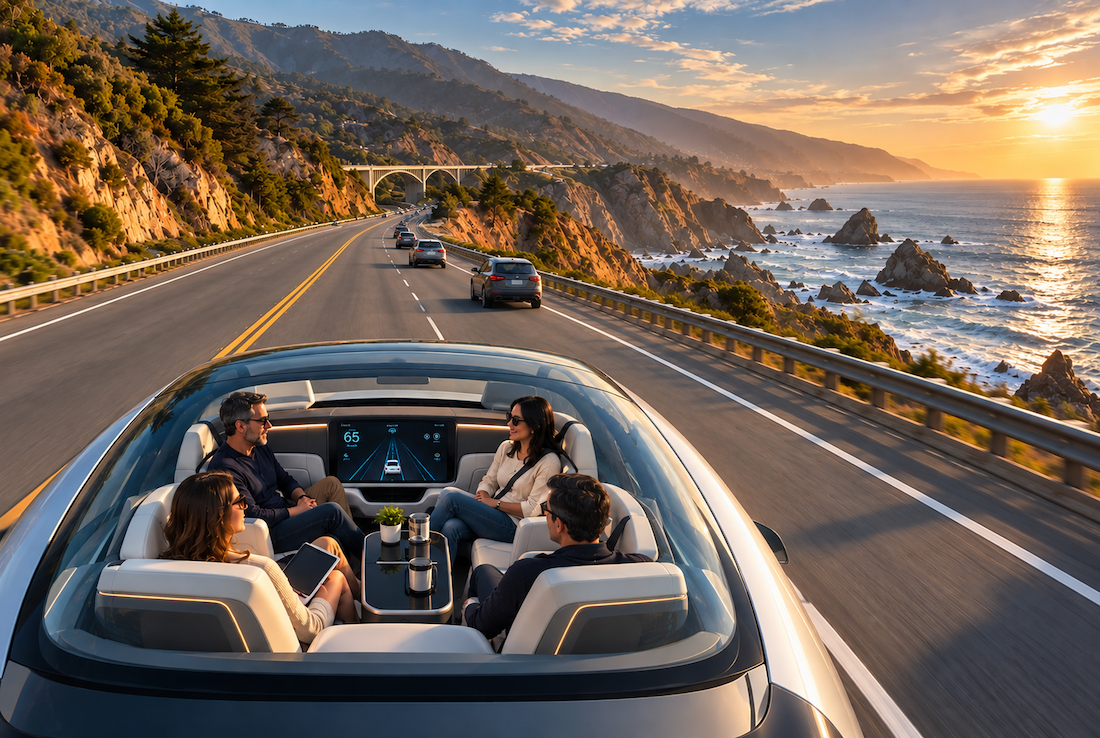
Research, some text and image by ChatGPT.


Mike asks, “But what if during the trip, another car turns left in front of you.” (Sic)
Probably a bad example. In this case, unless the self-driving car hit the go button instead of the whoa button, it is not at fault. The other driver gets cited.
Wes,
What is the car that turned in front of you is also a self-driving car?
Touche
Wes,
Perhaps I could have used a better example of a pending accident.
Thanks for pointing that out.
Mike,
Still an interesting question.