by Mike Gulett –
I was talking with a friend recently when he told me that he bought a new electric vehicle only because it has self-driving capability. He does not need a new car but he bought this one just because of the self-driving feature (although the driver is required to monitor the car and be prepared to take over driving at any time, so not full self-driving). I asked him why he needed self-driving and he did not really have a good answer but he made it clear he liked the idea and that he has a friend who has one and loves it.
This started me thinking about if the technology is really ready for self-driving. I also wonder about the user benefit of a self-driving system that requires the driver to be alert and ready to take over in real time. It seems to me that once drivers are aware that they must pay attention and be alert at all times during the trip just as if they were driving the car then this ‘self-driving’ feature loses some of its luster.
When we think about self-driving cars, many times the wrong question comes to mind. We ask whether an autonomous car is safe, whether we can trust a computer to drive and what happens if the computer makes a mistake.
But the question should really be:
Does the computer make fewer—and less consequential—mistakes than humans?
Because people do make many mistakes; we drive too fast, we drive when we are tired, we read our phones, we can become distracted by passengers, pets, screens and stuff happening outside the car, we follow too close to the car ahead, we misjudge turns and we can become impatient leading to the occasional erratic decision.
Some people drink too much and drive, some drivers fall asleep and some people just make a bad decision at the worst moment. And we have accepted all of this as part of driving. But now the computer has arrived and it is running the self-driven car and we expect it to be perfect, after all it is a computer.
The Machine Must Be Perfect
If a person causes an accident, we typically consider it an unfortunate event yet still understandable. There are millions of accidents every year and we continue to drive without questioning whether humans should be allowed to drive cars.
Yet when a self-driving vehicle causes an accident, it usually becomes national news. The big question is did the technology fail? Maybe it did. But that may not be the right comparison.
The proper question isn’t: Did the autonomous car make a mistake?
It is: Would a human driver have made more mistakes and more serious mistakes in the same situation?
This distinction can change the discussion. No self-driving system will ever be perfect. Neither are we (people). The real question is which one is better for all of us.
People Have Weaknesses
People are actually pretty good drivers considering all that driving demands. When I think about what happens when I drive down a busy city street; my brain monitors pedestrians, traffic lights, parked cars, bicycles, road signs, lane markings and other cars approaching from several directions — all at the same time. We try to predict what other drivers are going to do. We recognize that a child standing near the curb might suddenly run into the street without warning because that is what kids do sometimes.
I understand that a construction worker waving his arms may be more important than the traffic light behind him, so I follow his instructions. People have an excellent ability to understand context.
But we also have weaknesses: we get tired, we get distracted, we get angry, we drink alcohol, we can become impatient. Computers do not do any of these things.
Computers Have Different Weaknesses
Computers are very good at dealing with situations they have been programmed to handle. The problem comes when something happens that they do not understand and have not been programmed to handle.
Imagine driving along a country road and seeing a woman standing in the roadway waving her hands. A person immediately begins trying to understand the situation. We think, is something wrong? Maybe an accident or the road is flooded. Maybe she needs help.
People do not know what is happening, but understand they should slow down and be cautious. A computer sees images, moving shapes, motion and calculates some probabilities. A person is detected. Maybe the road is blocked. The computer converts digital information into an attempt at understanding. This is a difficult problem.
People are quite good at dealing with the unexpected because we possess something machines do not have (at least not yet) — common sense.
The Strange Problem of Rare Events
Most driving is usually easy: stay in our lane, drive the proper speed, keep a safe distance from other vehicles, stop at red lights and stop signs. The challenges are the one-in-a-million situation. Like: something falls from a truck, an animal suddenly appears, a police officer waves traffic through a red light, a construction team creates an improvised lane, a pedestrian doesn’t behave predictably, a car comes toward you on the wrong side of the road.
These situations are usually rare. But with millions of vehicles traveling billions of miles, rare situations happen every day to someone, somewhere. Self-driving vehicles must learn to deal with a nearly infinite variety of unusual events. This is one of the reasons self-driving has taken longer to develop than most people predicted. Driving may be easy to automate say 99 percent of the time but the remaining 1 percent is very difficult. Unfortunately, the final 1 percent may contain many of the situations where accidents can happen and that can be the difference between safety and tragedy.
Computers Have One Unusual Advantage
One feature where computers have a big advantage over humans is that they can learn collectively, yeah like the Borg on Star Trek.
If a person runs into a strange road situation and learns something from it, that knowledge mostly stays with each person. All of the other drivers do not magically acquire that knowledge.
Computers can work differently. If one self-driving vehicle comes across an unusual situation, the experience can be analyzed, incorporated into improved software and distributed across an entire fleet or an entire vehicle brand. One car learns and all others can benefit.
What Happens When the Computer Is Wrong?
On the other hand. When people make mistakes, those mistakes are almost always an individual mistake. They are not replicated throughout all people drivers.
However, a computer software defect can be replicated across thousands, or millions, of vehicles. The same mistake could exist in every car running that same software. This creates a new kind of automotive risk. This would be a systematic mistake that repeats itself until it is discovered and corrected.
This is why software validation, redundancy, cybersecurity and continuous monitoring are so important. Self-driving vehicles may eventually make fewer mistakes than humans but when they do make mistakes, we must ensure those mistakes cannot spread across an entire population of vehicles.
The Transition May Be the Most Dangerous Time
Perhaps the most problematic time is not a future filled with fully self-driving cars but it is now. Today we have vehicles capable of performing impressive amounts of self-driving while still requiring people supervision. This has created an awkward partnership where the computer drives and the human watches and monitors.
One problem is that people are not very good at watching machines perform boring tasks for long periods of time. Our attention fades and our confidence in the automation grows. Then at some random moment the computer runs into something it cannot handle.
Now the person must take over immediately.
The person must now change instantly from passenger observer to fully engaged driver. This can be a bad situation where the computer is not fully responsible and the person is not yet fully engaged.
There is a split second where responsibility is unambiguous, either the person is driving the car or the car is driving the person. In this in between moment is where danger lurks.
The Car Enthusiast’s Dilemma
For those of us who love cars, this raises another question. For us driving is not only transportation, driving a great automobile is one of life’s pleasures with all that includes, engaging with the car and the road.
A self-driving car may someday be a safer way to travel than people-driven cars. But that may not be enough for car lovers.
Maybe automobiles will someday divide into two worlds; for daily transportation, we use self-driving vehicles and for driving pleasure we manually drive our chosen vehicle in the same way horse lovers still ride their horses for pleasure.
The Question We Should Be Asking
The self-driving vehicle does not have to be perfect, it just needs to be better and safer than people drivers.
And before self-driven cars are turned loose on public roads we should demand evidence that they are better than people drivers. We need billions of miles of experience, transparent accident data, independent safety analysis. And clear legal responsibility when something goes wrong (this will be the subject of a future article). We have all of that now with people-driven vehicles.
We all should resist corporate marketing that asks drivers to believe a vehicle is more capable than it really is.
Someday the statistics may demonstrate that self-driven vehicles cause fewer accidents, fewer serious injuries and fewer deaths than people drivers. When that happens we may then face the question — should people be allowed to drive on public roads?
For those of us who love driving, that will be a very uncomfortable question.
Because the greatest threat to people-driven vehicles may not be government regulation, environmental policy or changing automotive fashion.
It may simply be statistics.
Let us know what you think in the Comments.
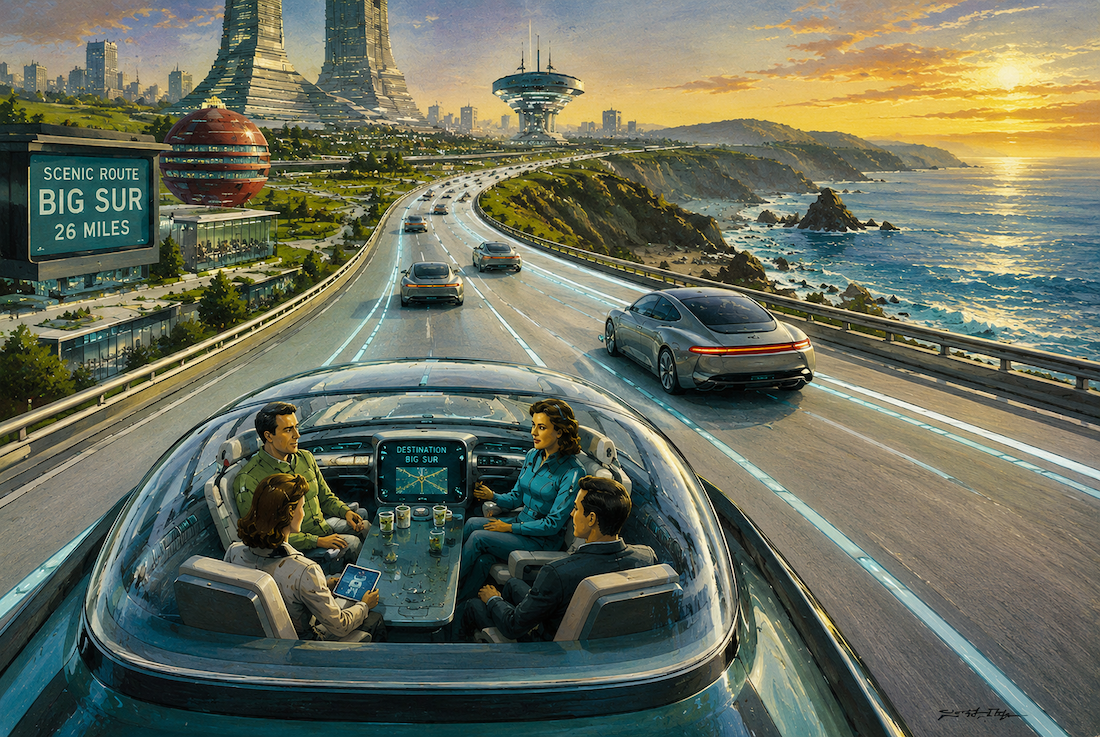
Research, some text and some images by ChatGPT.


Mike,been thinking this question alot,on surface computers should make less mistakes than people but recall the garbage in garage out, only as good as the software. Look at waymo cars,no driver. I wouldn’t get in one .
Max,
I too do not trust a fully self-driven car, at least not yet.
We need the detailed data collection I described above. And if there is a software mistake it will be replicated across all the cars who use that software as we have seen with our computers.
Mike, You bring up a number of what ifs.
I can only relate to what I understand now about my driving observations and my experiences as a luddite.
Just replaced a 2014 Audi A5 and my wife’s 2014 A4, both with 6 speed manuals. I like the brand but, like most other brands, you can’t get manual transmissions anymore. While the new automatics are good , interestingly, I find they don’t require a lot of attention or decision making while driving, in other words, I don’t have to pay as much attention as I used to with a manual.
Personally, I see more distracted driving because people now own computers on wheels so there only real decision is what music do I want to hear now, or who can I talk to on my iPhone.
Having had some track/racing experience, put me on a track with like minded folks in analog equipment and I feel safer.
That said, legal responsability changes when the owners car is self driving. The gods forbid, but you’re in a self driving car and you kill a pedestrian through no fault of your own, it’s the cars responsibility. Do you feel less emotion because you weren’t driving? Do you have a good attorney who understands the changes of responsibility or is the ultimate responsibility still yours?
I’m staying self determining as long as I can.