by Mike Gulett –
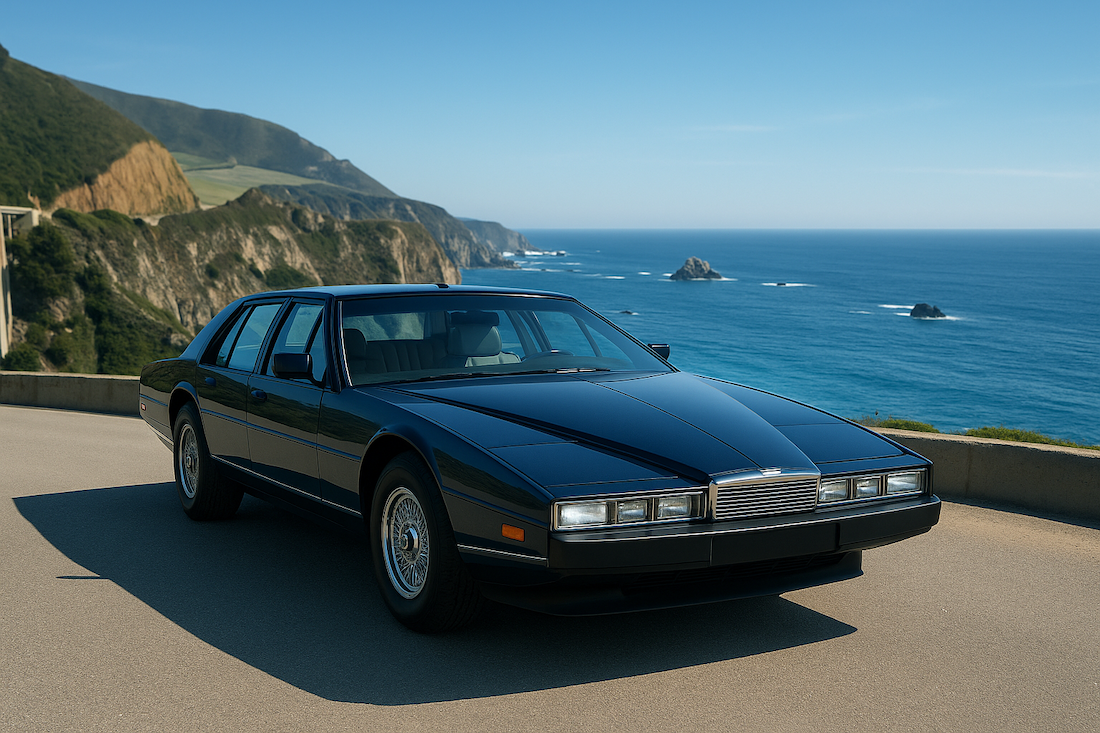
Some cars become icons because they are beautiful. Others because they are fast, rare, or tied to some cultural moment. But the Aston Martin Lagonda, especially the wedge-shaped, digital-instrumentation Series 2 launched in 1976, earned its place in history because it dared to leap into the future ahead of any other car model.
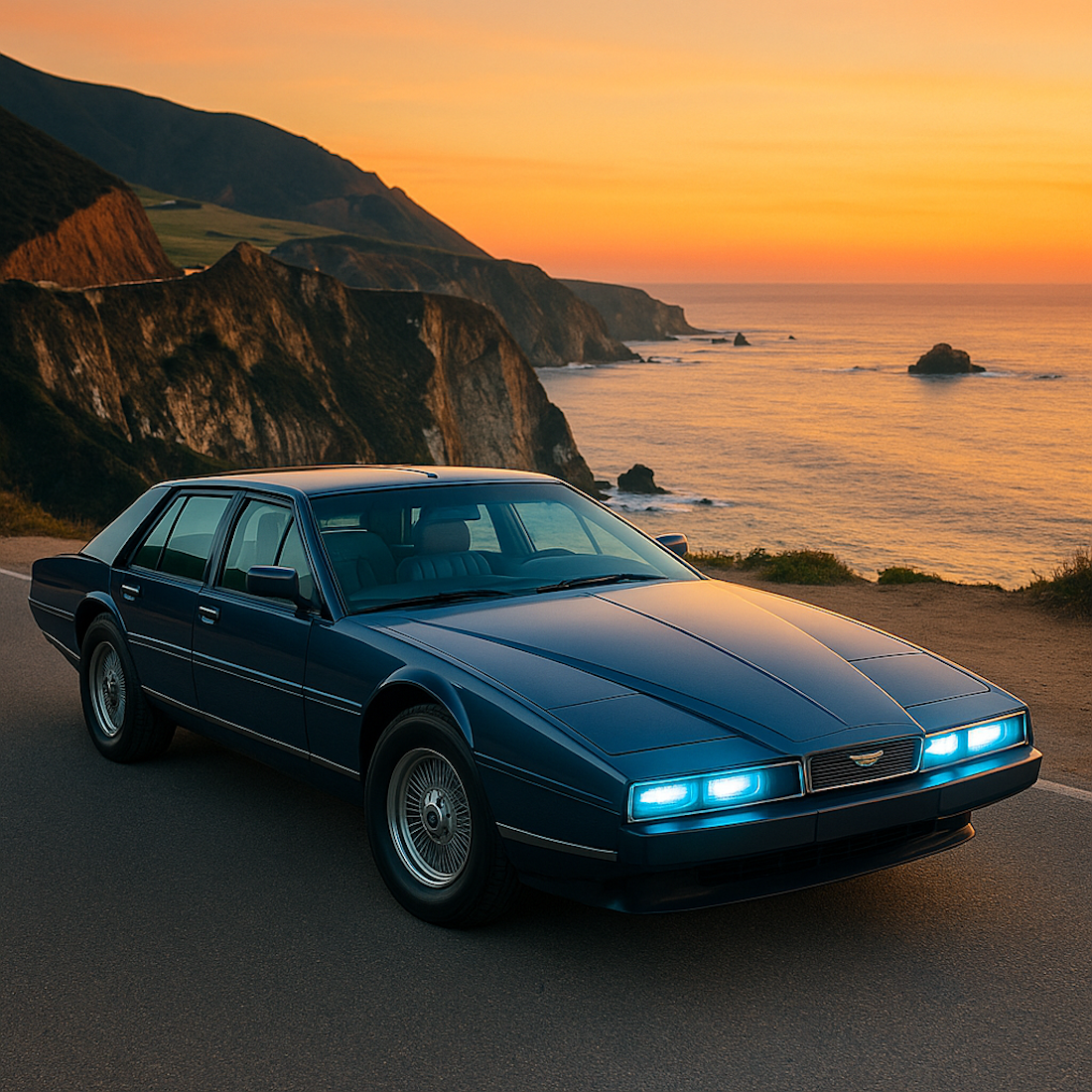
Part avant-garde design study, part technological moonshot, and part British luxury car experiment, the Lagonda has become one of the most fascinating cars ever built. Today it stands as a symbol of bold automotive thinking. It also has a polarizing style, many hate it and a few love it.
I first saw a Lagonda in person in the early 1980s at a small car show at the Hilton Hotel in Palo Alto, California. I was dumbfounded by this design. I learned that that Lagonda was owned by Jerry Sanders, the founder of the semiconductor company AMD. He was a well known lover of exotic cars.
A Radical Concept
When the Lagonda debuted, luxury sedans from Mercedes-Benz, Rolls-Royce, and Jaguar were traditional: upright, polished, formal. Quiet status was the style.
The Lagonda style shouted.
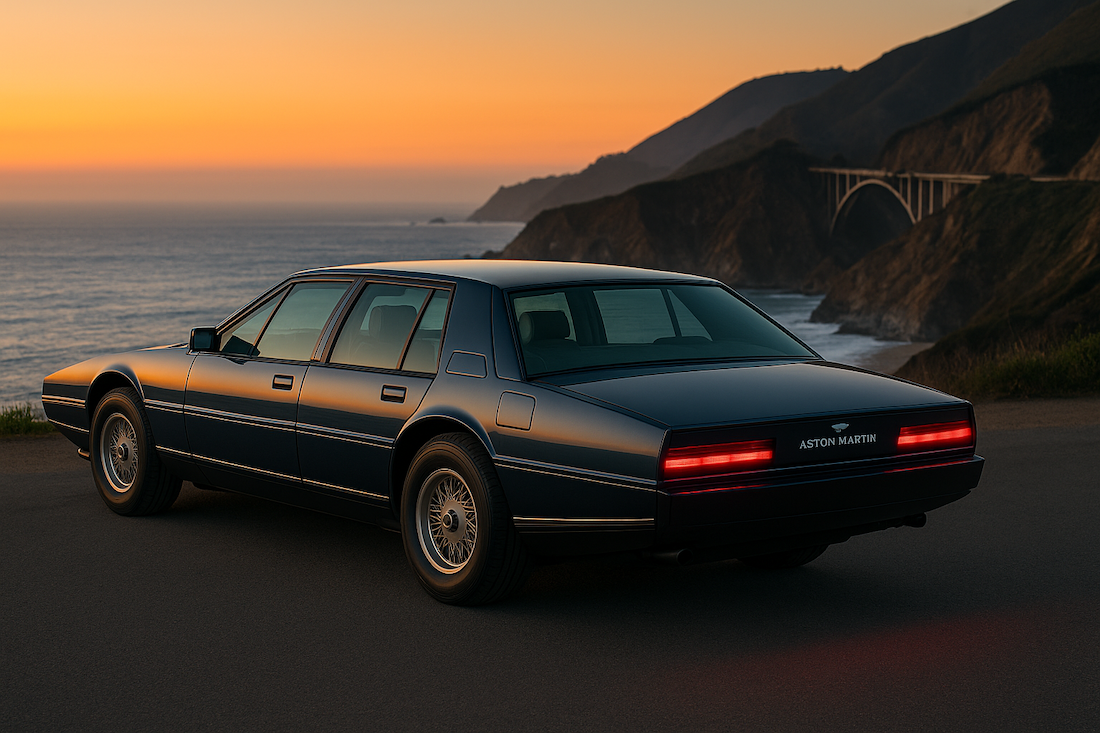
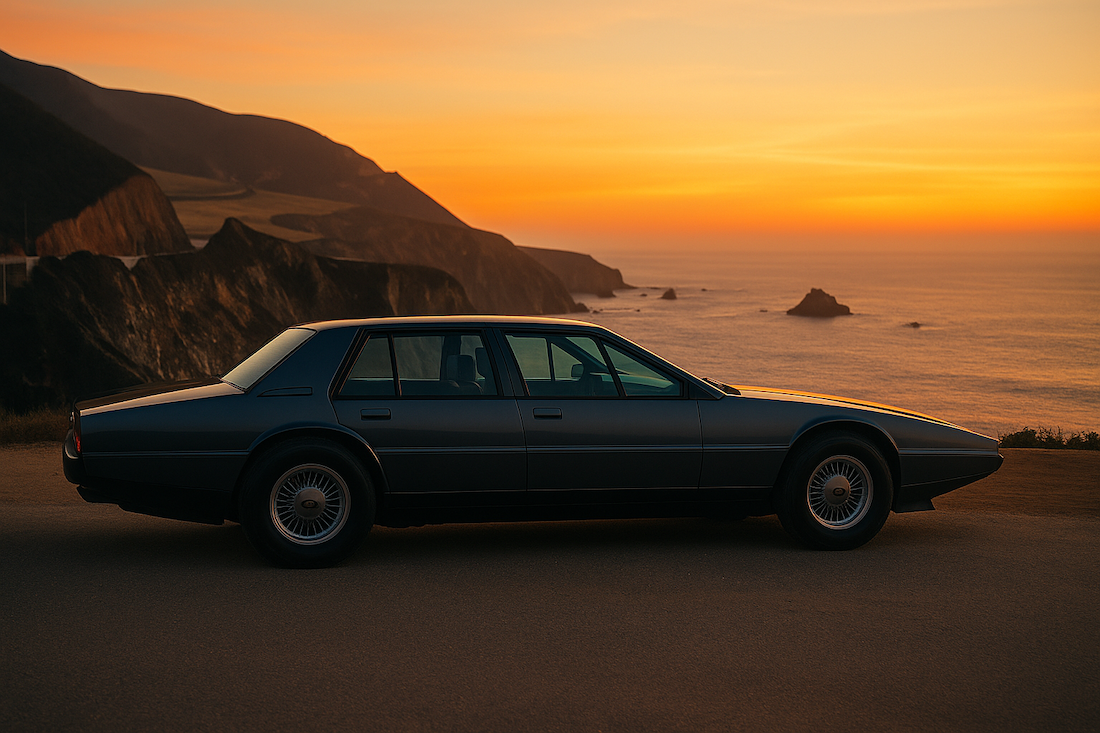
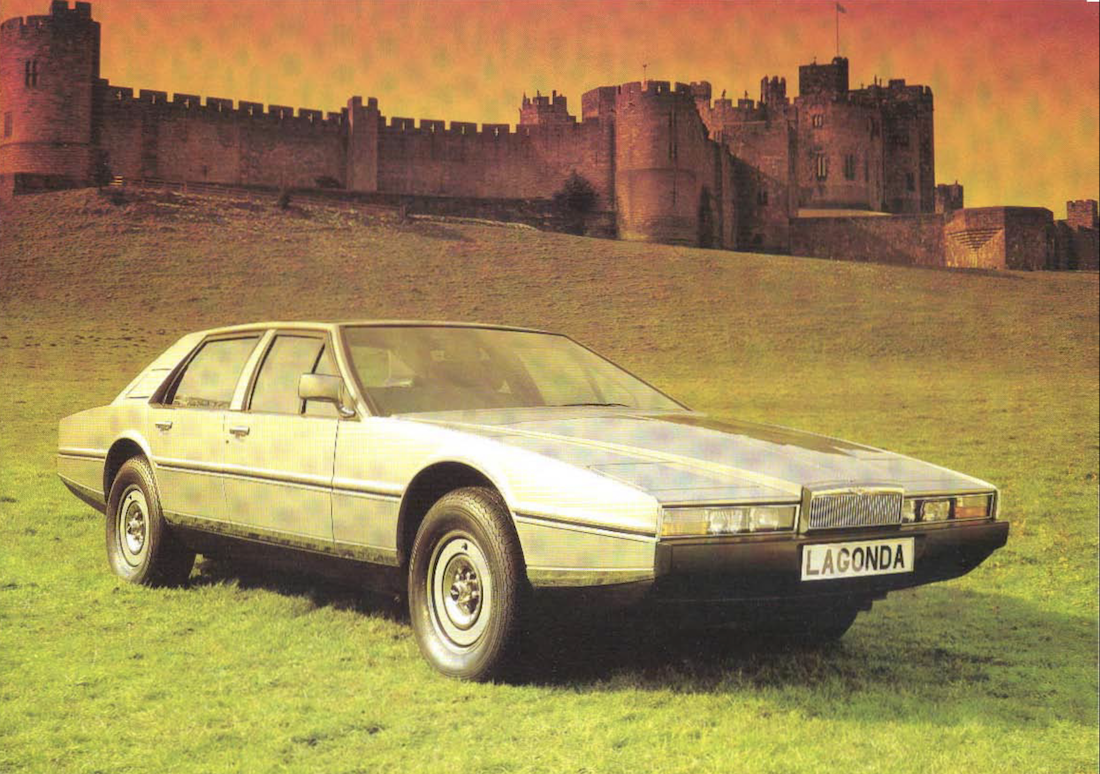
Chief designer William Towns sculpted a shape unlike anything before it; a long, low, origami-sharp wedge with impossibly flat surfaces and futuristic proportions. It looked like a spacecraft for the rich rather than a luxury car. At a time when computers were not yet common, Aston Martin envisioned a car that would put a digital future directly into the driver’s hands.
The Digital Dashboard
One of the Lagonda’s defining traits was its instrumentation. Aston Martin partnered with aerospace suppliers to produce something that felt lifted from a science-fiction movie. The first prototypes featured:
-
Vacuum-fluorescent displays
-
Touch-sensitive controls
-
Computer-controlled climate and vehicle systems
Today, such concepts seem normal—touchscreens, integrated systems, digital clusters. But in the 1970s, this was far out.

Unfortunately, it was also extremely temperamental. Electronics were fragile. Systems overheated. Sensors failed. The earliest buyers received manuals, service-support phone numbers, and occasionally factory engineers to diagnose gremlins.
Yet, when everything worked, the Lagonda felt like a glimpse of the automotive future, one that, arguably, didn’t fully arrive until the 2000s.
A Handmade British Saloon
Under its dramatic form, the Lagonda was still very much an Aston Martin. It featured:
-
A 5.3-liter V8, capable of smooth torque rather than outright speed
-
Hand-stitched Connolly leather
-
Deep wool Wilton carpets
-
A sense of bespoke craftsmanship
This wasn’t mass-manufactured luxury it was tailored luxury. Each car took months to build, personalized for clientele who often wanted something unique. In total, only about 645 Lagondas were built between 1974 and 1990 across four distinct series, making it one of the rarest luxury sedans ever produced.
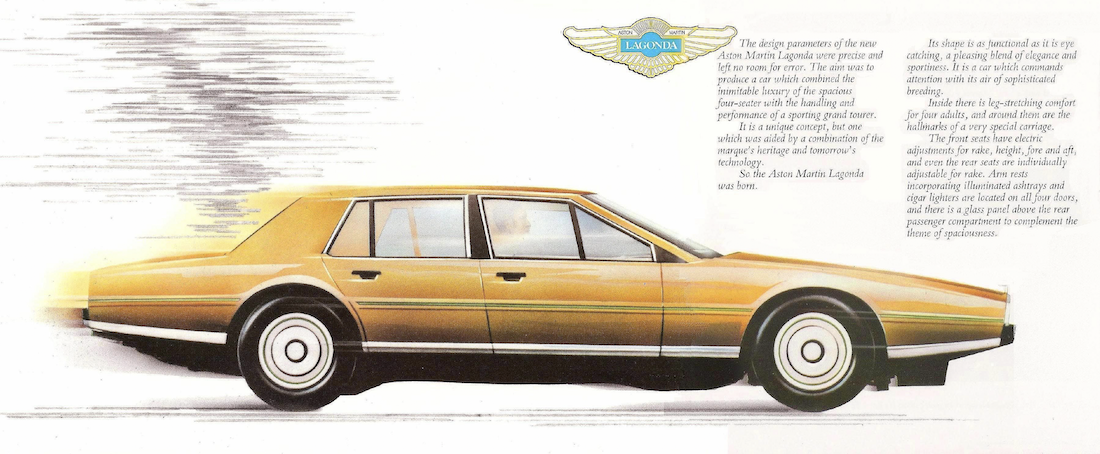
A Cultural Moment and a Status Symbol
The Lagonda became the ultimate statement car for:
-
Oil-rich Middle Eastern royalty
-
Entrepreneurs of the booming late-1970s and ’80s (like the founder of AMD)
-
Owners who wanted not just luxury, but conversation-starting exclusivity
In the Middle East especially, the Lagonda became a symbol of wealth and modernity, an automotive expression of new technological ambition. Aston Martin delivered many cars to Saudi Arabia, Kuwait, Oman, and the UAE, where their futuristic presence fit the zeitgeist perfectly.
Criticized in Its Time Yet Celebrated Today
Reviews in period were mixed. Many praised the concept, while others questioned its unnecessary complexity. But time has been kind to the Lagonda.
Today, collectors see it as:
-
A cultural artifact of late-20th-century futurism
-
The first true “digital car”
-
A design landmark alongside the Lamborghini Countach, Lamborghini Espada, Lotus Esprit, and Citroën SM
Values have risen steadily as younger enthusiasts—particularly those nostalgic for retro-futurism—rediscover its cultural power.
What Makes the Lagonda Special
The Aston Martin Lagonda is special not because it was perfect but because it was visionary.
It represents:
-
A car company daring to innovate when its survival wasn’t guaranteed
-
A design language that pushed boundaries rather than copying trends
-
A technological gamble that foreshadowed modern luxury cars
-
Hand-built craftsmanship fused with experimental electronics
-
A time when cars could still be eccentric, unapologetic statements
The Lagonda was a moonshot and moonshots usually aren’t tidy. But they can shift the future.
Conclusion
The Aston Martin Lagonda is one of the most important automotive risk-takers of the 20th century. In a world increasingly filled with homogeneous luxury technology, its electric-blue digital gauges, wedge-shaped body, and uncompromising personality feel refreshingly human.
It remains a reminder that greatness is rarely safe and that sometimes the most memorable cars are the ones that try something no one else would dare attempt.
Let us know what you think in the Comments.

Research, some text and some images by ChatGPT 5. Some images compliments of Aston Martin.


I always felt that the Aston Martin Lagonda was kind of a British “pimp mobile”. It seemed as unpractical a car to the Aston Martin image as the Cadillac Cimarron was to the Cadillac image.
I guess I’m one of the few who has always loved that particular wedge design. It was a bold decision for AM, a company that was always struggling financially, to embark on a design and a technology that many considered risky. Looking at what the US car companies were designing in the late 1970s to mid 80s, I applaud their decision to think outside of the box, or in their case, recreate the box.
Mike,
The AM Lagonda was, indeed, a beautiful design, especially when you see it in person – pictures don’t really do it justice.
I used to run into two of them in different parking lots in Lower Manhattanan, on the West Side, one of them a dark blue and one of them black, and they just blew me away. The styling was not what hindered its success, but rather the electrical gremlins that you mentioned. Once the reliability of the model was questioned, people stayed away from it.
Glenn in Brooklyn, NY
I know that a lot of people really like this design. However, I dispute that, as I don’t think people are excited about the design as they are about the proportion of the car and the extreme packaging of the interior space. The proportion is dramatic, however, the design on that framework is poorly executed. It is very crude. I will explain, please keep an open mind.
If you look at the offsets of the belt, they are very thick and heavy looking, also body side surfaces do a lot of twisting, which is literally unheard of for a modern automobile.
Imagine if, this car had been designed by Georgetto Giugiario. I guarantee that the design of the car would match It’s dramatic proportion. In fact, I believe that the proportions itself would be significantly improved.
Another issue that I have with it is the form language, the character of the surfaces. It has a multiple form characters, and does not display a
consistentcy of surface.
Overall, the Rapids, is a much more beautiful car and it’s overall character. It has great drama that takes advantage of minimal rear seating. That car without a doubt is outstanding.
Dick the oil rich seemed to care little about surface tension nor offsets at the belt line. Look at me was their only motivation for buying .