by Mike Gulett –
The Ford GT40 is one of the most important racing cars ever—an American engineering answer to European dominance that reshaped endurance racing and created a legend that still echoes through motorsport and collector car culture today.
Origins
The GT40’s story begins with the bruised ambition of a car mogul. In the early 1960s, Henry Ford II sought instant credibility on the world racing stage. When negotiations to purchase Ferrari collapsed, Ford redirected its resources toward beating Ferrari at its own game—endurance racing. Remember the movie Ford vs Ferrari? Well it was something like that.
The target was clear: 24 Hours of Le Mans, where Ferrari had been nearly unbeatable. Ford would not merely compete; it wanted to win it all.
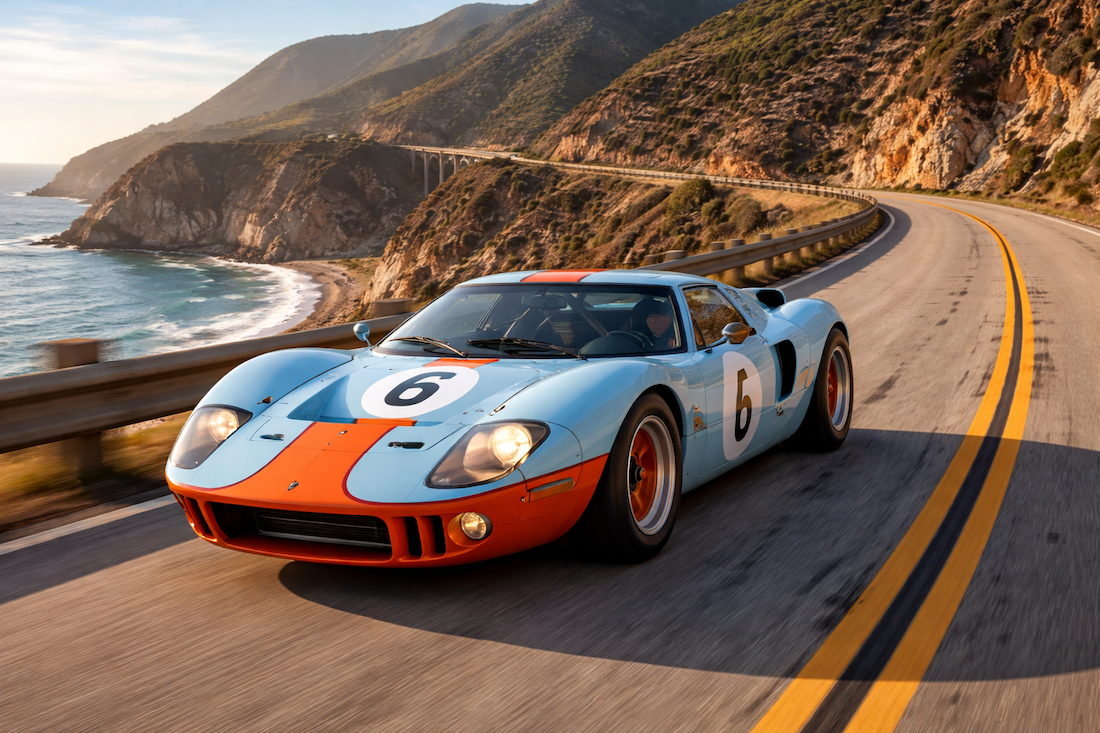
Engineering the GT40
Ford partnered with Britain’s Lola and brought in elite minds, including Eric Broadley and later Carroll Shelby. The result was a purpose-built prototype racer with a low, wide stance—named “GT40” for its height: just 40 inches off the ground to the top of the roof.
Early versions (Mk I) were quick but fragile. Reliability failures plagued initial Le Mans attempts. Ford responded with brute force and relentless development, culminating in the Mk II with a 7.0-liter Ford V8—derived from NASCAR—and a fortified chassis built to survive 24 hours at full attack.
It looked beautiful as well.
Carroll Shelby
By late 1964, Ford had poured enormous resources into the GT40 program, yet the results were very disappointing. The car was quick but unreliable, plagued by drivetrain failures, braking issues, and poor race execution. Ford needed someone who understood European racing, American V8 power, and—most importantly—how to win races.
Carroll Shelby was the obvious choice. He had already delivered results for Ford with the Cobra and was respected in Europe and the US. He had won Le Mans as a driver in 1959. When Ford handed Shelby control of the GT40 race program in early 1965, the mandate was blunt: win Le Mans.
Victory: Le Mans 1966–1969
In 1966, the GT40 achieved what Ford set out to do: a dominant 1-2-3 finish at Le Mans, humiliating Ferrari on the world stage. It wasn’t a fluke.
-
1966: GT40 Mk II – Historic 1-2-3 sweep
-
1967: GT40 Mk IV – All-American car, driver, and team
-
1968–1969: GT40 Mk I – Back-to-back wins under new regulations
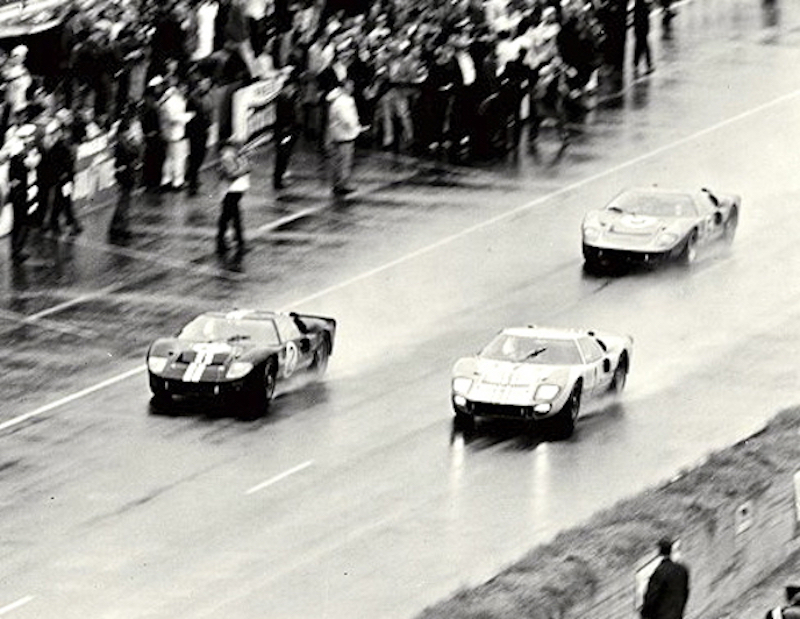
1-2-3 – 1966 Le Mans -Ford GT40 – Ford Archives
- Chassis P/1046 (1st Place): Car #2, driven by Bruce McLaren and Chris Amon, which won due to starting farther back on the grid than the others.
- Chassis P/1015 (2nd Place): Car #1, piloted by Ken Miles and Denny Hulme, which led most of the race before the staged photo finish.
- Chassis P/1016 (3rd Place): Car #5, driven by Ronnie Bucknum and Dick Hutcherson, completed the podium sweep.
Four consecutive Le Mans victories remain unmatched by any American manufacturer.
Why the GT40 Matters
1. It Changed Motorsports Power Dynamics
The GT40 proved that American cars could defeat Europe’s finest cars not just with money, but with engineering discipline, testing rigor, and team execution. It forced a global rethinking of how endurance racing programs were built.
2. It Redefined Ford’s Identity
Before the GT40, Ford was primarily associated with mass-market cars. After Le Mans, Ford had motorsport credibility—and a performance halo that influenced everything from Mustangs to later GT programs.
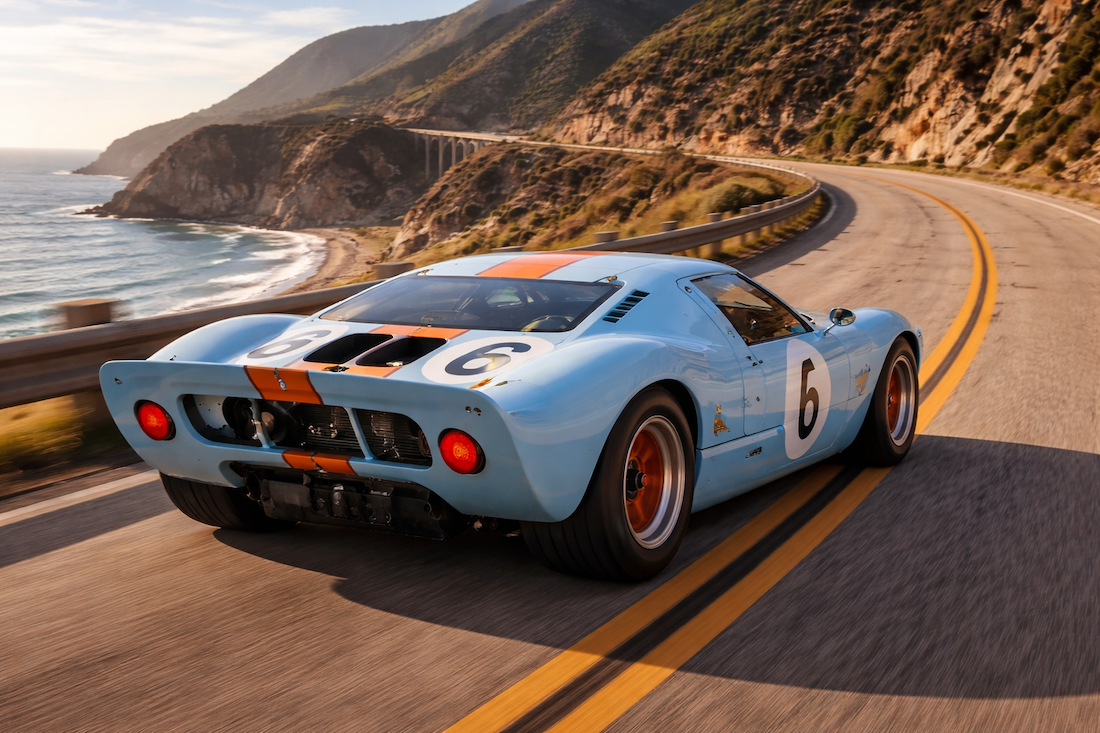
3. It Became a Design and Cultural Icon
The GT40’s proportions—low nose, wide haunches, central stripes—are now visual shorthand for speed and purpose. Few race cars are instantly recognizable to non-enthusiasts; the GT40 is one of them.
4. It Created a Lasting Bloodline
The GT40 directly inspired the modern Ford GTs of 2005, 2017, and beyond. Each revival traces its DNA—stylistic and philosophical—back to the Le Mans winner.
Legacy Today
Original GT40s are among the most valuable competition cars in the world, often trading hands privately for eight figures. More importantly, the car’s story—industrial pride, rivalry, and redemption—continues to resonate because it feels earned. The GT40 wasn’t elegant in the Italian sense; it was relentless, strategic, and effective.

The only slot car I have left from the 1960s is this Ford GT40
In Perspective
The Ford GT40 is not merely a racing car. It is a statement—proof that determination, resources, and engineering clarity can create history. For Ford, for Le Mans, and for motorsport itself, the GT40 stands as one of the greatest of racing triumphs.
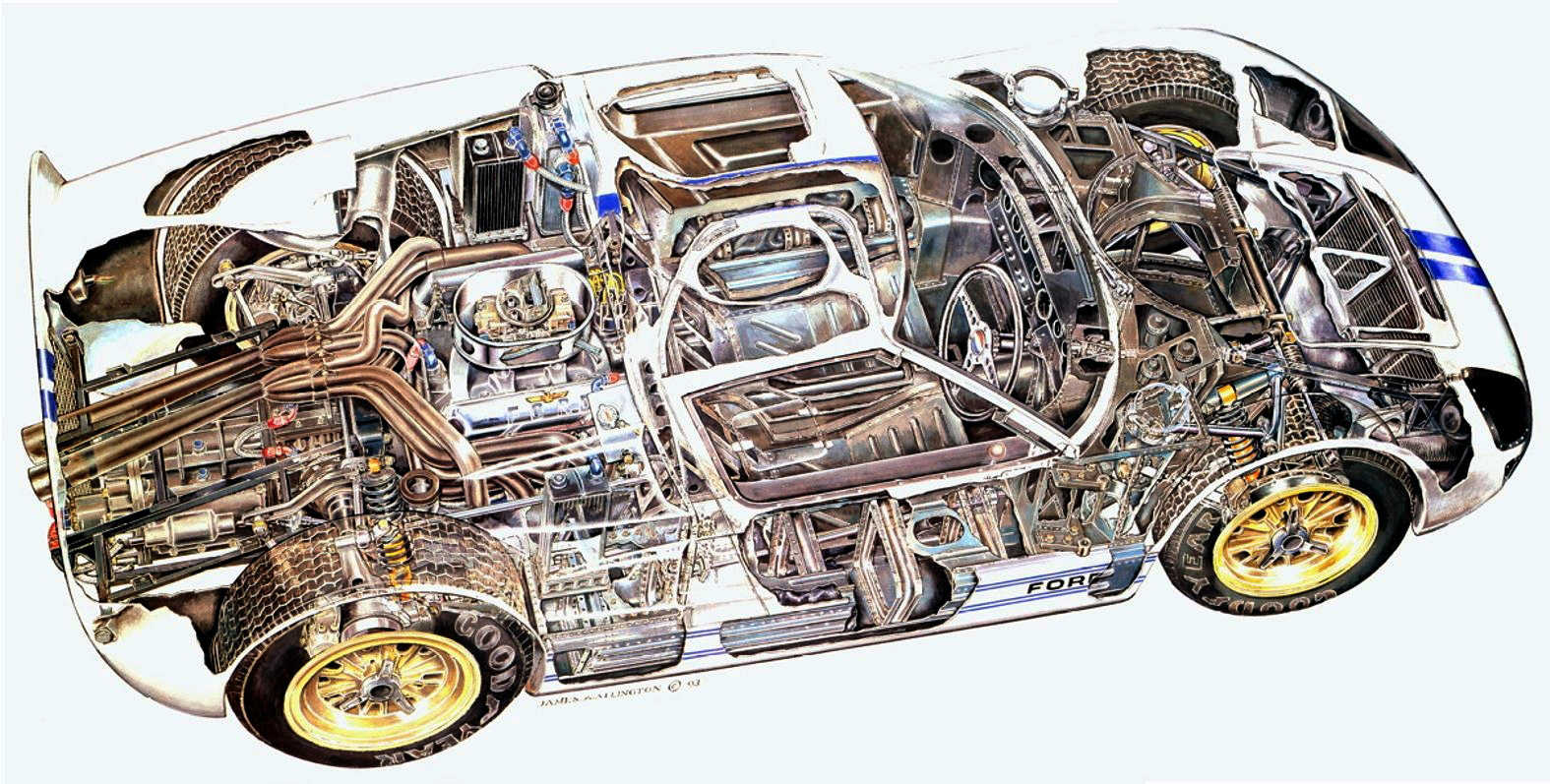
Ford GT40 Cutaway Drawing
Let us know what you think in the Comments.

Research, some text and some images by ChatGPT 5.2.


Mike:
Great overview of not just an American icon, but a world one as well.
In response to point #3, that it became a “Design and Cultural Icon”: While Marcello Gandini has received credit for designing the fabled Lamborghini Miura, an interview of Giorgetto Giugiaro a couple of decades ago in Classic and Sports Car magazine revealed that he was the one that did the the original design work for the Miura (he pointed to drawings he had in a large drawer) before he left Bertone to open his own firm, Ital Design. Gandiini finished the project and helped get it into production.
But what was Giugiaro’s inspiration? He said in the interview it was the Ford GT 40! Even a casual glance at the two shows the many similarities.
I’m not a Ford man, but I am proud of the American Ford GT.
Robb,
I did not know that about the Miura and GT40 but the similarities are there.
Thank you for the precis on the car. I’ve always loved the GT40 for its raw energy that demands attention but I favor the Mk IV for the more refined and elegant lines.
Road & Track had an article long ago that showed a cutaway illustration of Eric Broadleys Lola (some brain synapse vaguely says it was called the 47?). I loved the simple elegance of its lines as well.
The whole story of various talented individuals coming together in a series of collaborations through those years, each contributing significant innovations (along with Ford $$$) to have such a powerful impact on the sport and automotive history is astounding.
I’m reminded of the events described in the book Faster by Neal Bascomb – the unlikely intersection of driver, car, and backing was impactful for its era.
I am sorry that most GT40s i have seen in person had the ol’ VW rwin pipes squeeling from behind! I had seen a modern reproduction back in the 1990s, but even it had extra frame improvements to lessen torsional twisting, and a Ford 460 that had mostly exhaust tubing, rather than the interesting intake apparatus from the 1960s just under the rear decking.
Mike,
The retro 2005/2006 Ford GT tribute car models are quite amazing in their appreciation in value. The MSRP was $150,000 with four available options (stripes, forged BBS lightweight wheels, McIntosh Sound System, painted Brembo brakes), and now you cannot touch one for less than $650,000. The Heritage Edition (Gulf Heritage Racing Colors) was a $13,000 option, that has pushed those models to over $750,000.
I have never seen a fairly recent American car appreciate in value like the the Ford GT. It is one car whose values I watch closely, and have watched them rise from $300,000 to the current astronomical values.
Glenn in Brooklyn, NY.