by Mike Gulett –
In this time we live in defined by kilowatts, software updates, and silence at full acceleration, the V12 engine should be extinct but it is not. It is large, inefficient, complex to build and service, and maybe politically inconvenient. And yet it refuses to die or disappear.
Across the upper reaches of the automotive world, a handful of marques continue to defend the V12 not as a performance solution, but as a cultural treasure. Ferrari, Lamborghini, and Aston Martin are not clinging to the V12 out of nostalgia or stubbornness. They are preserving it because it represents something that electric cars—however brilliant—cannot replace.
The V12 has quietly shifted roles. It is no longer a cutting-edge answer to speed. It is a monument to technical excellence.
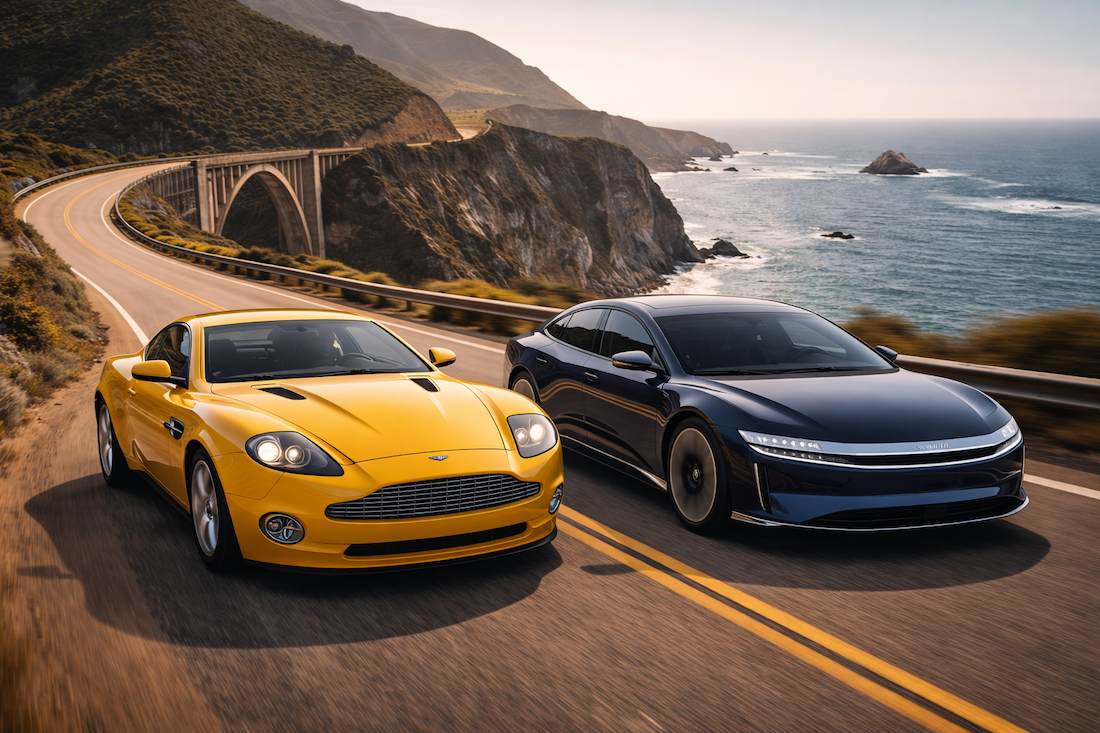
Aston Martin Vanquish S and Lucid Air Pure
Our V12 Aston Martin and Lucid Air Pure Electric Car
I have had some experience with V12 engines over the years, the latest being a 2005 Aston Martin V12 Vanquish S, which is sitting in the garage next to an all electric 2026 Lucid Air Pure. The Lucid Air has been with us about one month and I have driven it regularly and find it quite a fun and satisfying drive.
The Lucid Air Pure has 430 hp compared to the Vanquish’s 520 hp. They both are very quick with 0 to 60 mph at 4.5 seconds for each and more than 200 mph top speed for the Aston Martin and 124 mph for the Lucid. But do I really care about top speed beyond bragging rights?
The Aston Martin is a little lighter at 4,133 lbs compared to 4,564 lbs for the Lucid Air – yet the 0 to 60 mph time is the same and I suspect this is because of the instant power from the electric motor versus waiting until 5,800 rpm for the peak power on the Aston.
The sound of the Aston Martin naturally is much more engaging than the very quite Lucid Air.
Beyond Performance Metrics
The modern V12 is not trying to win technical battles. In a world where electric super cars can out-accelerate any production car on four wheels (the Lucid Air Sapphire accelerates from 0 to 60 mph in 1.89 seconds), but raw numbers are beside the point. The appeal of twelve cylinders arranged in symmetry lies elsewhere.
A V12 does not shout; it sings a song to us all. Its power delivery is uninterrupted, fluid, and eerily calm even at absurd speeds. Where turbocharged engines punch and electric motors surge, a V12 builds speed like a tide—inevitable and serene. That sensation is not faster. It is much deeper than just speed.
Car manufacturers understand this. Today’s V12 cars are rarely marketed on lap times or drag races. Instead, the emphasis is on craftsmanship, lineage, and the feeling of something mechanical working in harmony with the driver.
Sound as Identity
Sound has become one of the most endangered qualities in the automotive experience. Artificial noise generators and synthesized exhaust notes attempt to replace what regulation has muted. The V12 stands apart because its voice is intrinsic and cannot be replaced by synthetic sounds.
There is a complexity to a V12’s sound, layers of harmonics rising and falling together, that cannot be convincingly replicated. It is neither aggressive nor polite. It is an orchestra playing for the pleasure of the driver and anyone else who is listening.
For brands built on emotional engagement, this does matters. The sound of a V12 is not decoration; it is intrinsic identity. It connects modern cars directly to endurance racing, grand touring, and the golden age of mechanical excess. Silence may be efficient, but it is culturally a blank.
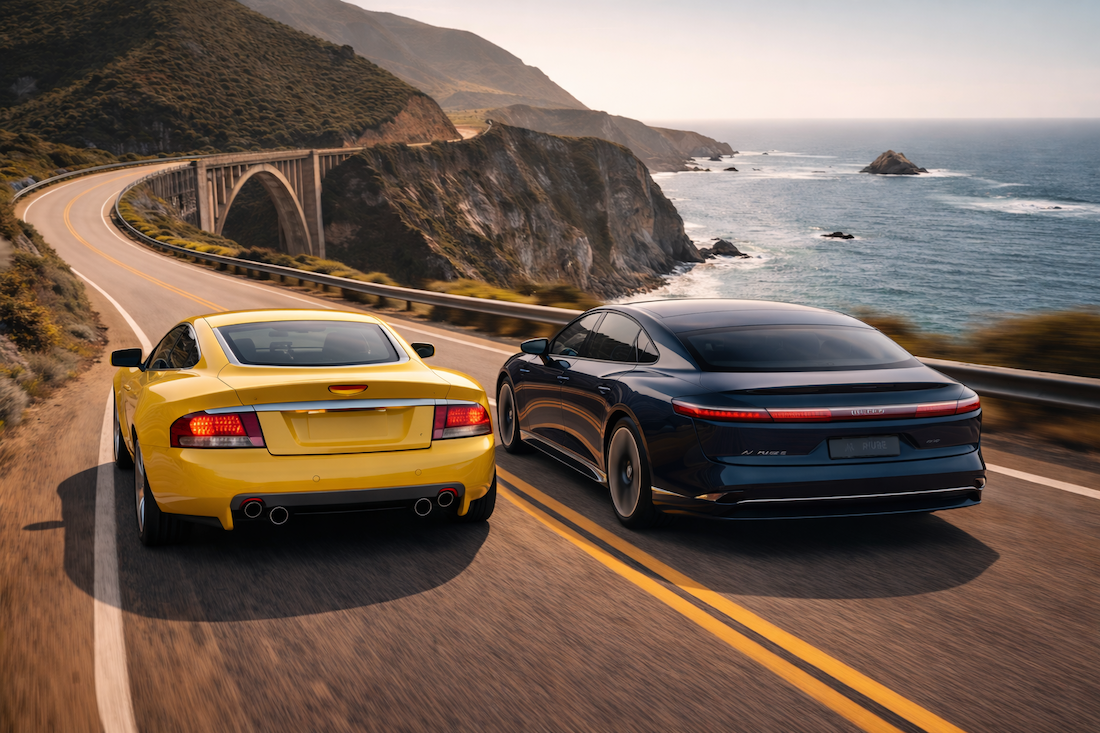
Aston Martin Vanquish S and Lucid Air Pure
A Mechanical Last Stand
The continued existence of the V12 is not denial—it is acknowledgment. These engines are built with full awareness that their days are numbered. That knowledge does gives them and their creators a clarity of purpose.
Today’s V12-powered cars are often naturally aspirated, intentionally over-engineered, and unapologetically indulgent. They exist not to comply, but to conclude. In that sense, they resemble the final steam locomotives or the last hand-built mechanical watches before quartz took over. And mechanical watches are still going strong today even though a quartz watch is much more accurate and easier to care for.
Why These Brands Won’t Let Go
Ferrari’s V12 lineage stretches back almost to the company’s origins. Lamborghini’s identity was forged around excess, rebellion, and cylinders counted in double digits. Aston Martin’s V12s have long embodied effortless, aristocratic speed. Removing the V12 from these brands would not simply change their product lineup—it would sever a narrative thread to their history.
Electrification seems to be inevitable. These manufacturers are already embracing it in parallel. But the V12 serves as a counterweight, reminding buyers and designers what made these marques matter in the first place.
The V12 is not about progress but is about a continuity of purpose and intent.
Rolling Monuments
Seen through a modern lens, the V12 is no longer obsolete—it is ceremonial. Like a cathedral organ in a digital age, the relevance lies not in practicality but in the presence. It reminds us that engineering can be expressive, emotional, and maybe excessive without any need for apology.
The quiet presence of the V12 is not a comeback story. It is a farewell tour, conducted with dignity and intent. These engines are being built not because they must be—but because they should be.
And when the last one finally falls silent, it won’t mark failure. It will mark a completion.
Let us know what you think in the Comments.


Research, some text and some images by ChatGPT 5.2
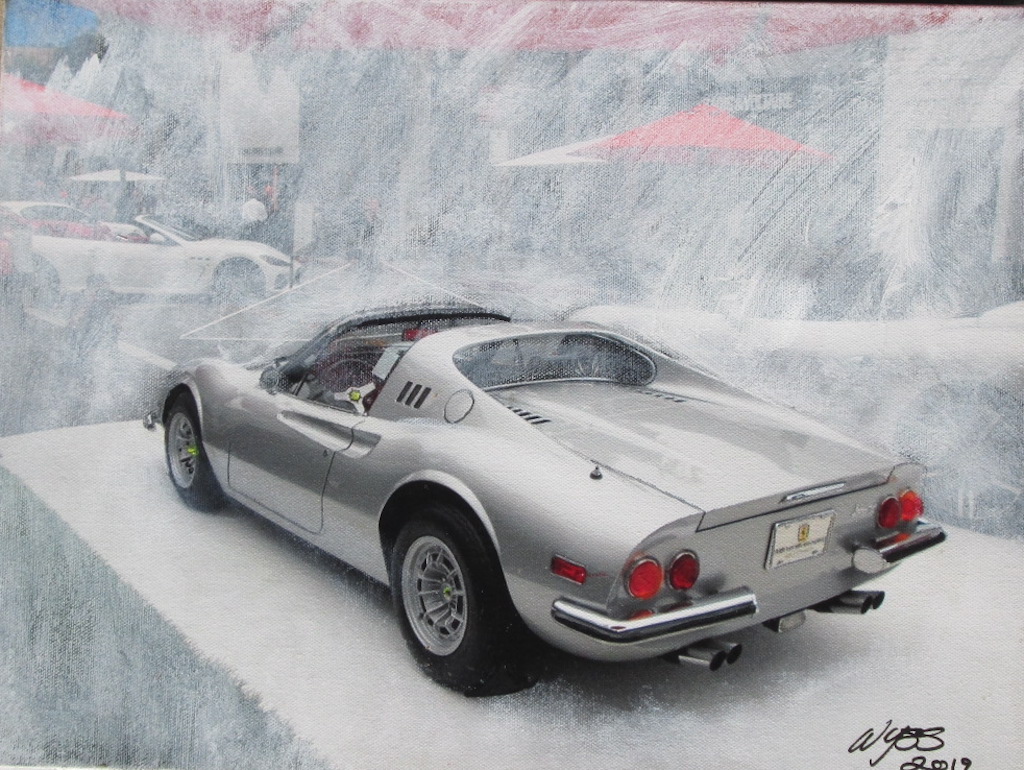


I currently drive a ’56 Ferrari 250 GT, and an ’05 Bentley Continental GT. I can’t imagine them powered by anything other than their V12s. I love the smooth, constant power of the V12, so much so, that I’m in the market for a ’33-34 Packard 12 cars The only thing better would be to have two V12s! Maybe a P-38 Lightening?
Totally agree with your article, in a world of soulless excellent automobiles, these magnificent machines echo a wonderfully excessive past filled with passion and the love of driving, we all know that the high end electric cars are quicker, but we take comfort in the blissful mechanical sounds
In a world filled with noise and distraction, nothing soothes my soul then a Drive in a V12 powered Ferrari. It’s a symphony to my ears, and quells my mind. The smell of leather, and the peacefulness you experience, you just can’t find it any place else.
There is nothing more beautiful automotive-wise than hearing a Ferrari V-12 accelerate. No other car engine or even V-12 engine makes a melody quite like it.
Glenn in Brooklyn, NY.
Miniaturization and complexity are mechanical ambrosia……